
What Is Process Failure Mode and Effects Analysis (PFMEA)?
El análisis modal de fallos y efectos del proceso (PFMEA) es una herramienta esencial en industrias donde la fiabilidad del proceso y la calidad del producto son fundamentales. Implica un análisis detallado de los pasos del proceso para descubrir posibles puntos de fallo y evaluar sus efectos en el proceso global. Este análisis incluye:
- Identificación de los modos de fallo: Determinar cómo puede fallar un proceso en cada paso.
- Evaluar los efectos: Evaluar las consecuencias de cada fallo sobre el proceso y el producto final.
- Priorización de riesgos: Asignar un Número de Prioridad de Riesgo (RPN) basado en la gravedad, ocurrencia y detección de cada modo de fallo.
- Implementing Actions: Develop and implement strategies to reduce or eliminate high-risk failure modes.
While a failure mode and effects analysis (FMEA) identifies equipment failures and potential breakdowns, a PFMEA looks at the manufacturing process as a whole. Portions of the process examined could include purchasing raw materials, storage, manufacturing, assembly, packaging, and shipping.
PFMEA es un enfoque sistemático utilizado para identificar y evaluar fallos potenciales en un proceso de fabricación o empresarial. El objetivo de PFMEA es mejorar los procesos mediante la identificación de modos de fallo, la evaluación de su impacto y la aplicación de medidas correctivas para mitigar los riesgos. Al examinar cada paso de un proceso, el PFMEA ayuda a las organizaciones a aumentar la fiabilidad, mejorar la calidad y prevenir los defectos antes de que se produzcan.
El proceso PFMEA es un proceso de colaboración en el que participan equipos interfuncionales que aportan diversas perspectivas para identificar posibles problemas de forma exhaustiva. Esta colaboración garantiza que todos los modos de fallo posibles se tengan en cuenta y se aborden con eficacia.
PFMEA vs FMEA
Aunque el PFMEA es un tipo específico de Análisis Modal de Fallos y Efectos (FMEA), es importante comprender las diferencias y similitudes entre PFMEA y FMEA.
FMEA: FMEA es una amplia metodología utilizada para identificar posibles modos de fallo tanto en el diseño de productos como en los procesos. Abarca varios tipos, como el AMFE de diseño (AMFE-D) y el AMFE de procesos (AMFE-PF).
- Aplicación: Se aplica tanto al desarrollo de productos como a los procesos de fabricación para mejorar la fiabilidad y la calidad.
- Enfoque: Puede utilizarse para analizar diseños de productos (DFMEA) y procesos (PFMEA).
PFMEA: El PFMEA se centra específicamente en identificar y abordar posibles fallos en los procesos de fabricación o empresariales. Su objetivo es mejorar la fiabilidad y la eficiencia de los procesos.
- Aplicación: Se utiliza principalmente en entornos de fabricación y producción para garantizar que los procesos son sólidos y no presentan defectos.
- Enfoque: Se centra en los pasos y operaciones del proceso, identificando los modos de fallo que podrían afectar al flujo del proceso y a la calidad del producto.
Design FMEA and Process FMEA: Key Differences
- Ámbito de aplicación: El DFMEA se centra en el diseño de los productos y sus componentes, mientras que el PFMEA se ocupa de los procesos utilizados para fabricar los productos.
- Objetivo: El DFMEA pretende mejorar el diseño y la fiabilidad del producto, mientras que el PFMEA pretende optimizar la fiabilidad y la eficacia del proceso.
- Fase de aplicación: El DFMEA suele realizarse durante la fase de diseño y desarrollo del producto, mientras que el PFMEA se aplica durante el desarrollo y la fabricación del proceso.
Tanto el DFMEA como el PFMEA forman parte integral del sistema de gestión de calidad de una organización, y trabajan conjuntamente para garantizar que tanto los diseños de los productos como los procesos de fabricación sean sólidos y fiables, y cumplan las expectativas de los clientes.
Importance of PFMEA in Risk Assessment
As a proven process to identify, assess, and mitigate potential process failures, PFMEA is an essential component of your risk mitigation strategy. That’s because it allows you to:
- Uncover potential failure modes that could significantly impact development and production costs, health and safety issues, and more
- Analyze potential failures and rank criticality to prioritize solutions
- Determine production process improvements to reduce failures and enhance productivity
- Implement mitigation strategies, including a blend of corrective actions and preventive actions
- Adopt a continuous improvement approach across processes
This powerful quality risk assessment tool can save time and money while improving safety and customer satisfaction.
Cuándo realizar el PFMEA
A PFMEA can be time consuming. Due to its in-depth nature, it often requires a significant number of working hours and involves pulling team members from many departments.
Conducting a PFMEA for every process throughout the company doesn’t usually need to be performed regularly. But in some instances, performing a PFMEA can significantly reduce risks and improve processes. Examples include:
- When there’s a failure: A PFMEA should be completed when there’s a failure, especially when it’s impactful and your company wishes to avoid similar failures in the future.
- Cuando se produce un cambio en los equipos: Por ejemplo, se necesita un PFMEA si se han sustituido varias máquinas de la línea de producción por modelos más nuevos. En este caso, es posible que su equipo tenga que ajustar los programas de mantenimiento, el inventario de piezas de repuesto y las expectativas de tiempo de producción para reanudar con éxito las operaciones con el nuevo equipo.
- When there are process changes: A PFMEA should also be completed when new processes are introduced or current processes are significantly changed.
- After quality issues: If a process has experienced quality issues, PFMEA can be used to analyze the root causes and implement corrective actions to prevent recurrence.
- Compliance requirements: In industries with stringent regulatory requirements, PFMEA ensures that processes meet safety and quality standards.
By using PFMEA in these scenarios, organizations can proactively manage risks, enhance process reliability, and maintain high safety and quality standards.
Industrias que suelen utilizar el PFMEA
El PFMEA se utiliza ampliamente en diversos sectores en los que la fiabilidad del proceso y la calidad del producto son fundamentales. Estas son algunas de las industrias que suelen aplicar el PFMEA:
- Industria del automóvil:
- El PFMEA se utiliza ampliamente para garantizar la fiabilidad y seguridad de los procesos de fabricación de automóviles. Desde las cadenas de montaje hasta la fabricación de componentes, PFMEA ayuda a identificar y mitigar los riesgos que podrían provocar defectos o fallos en los vehículos.
- Aplicación común: Los fabricantes de automóviles utilizan PFMEA para analizar procesos como el montaje de motores, la aplicación de pintura y la soldadura, garantizando una producción de alta calidad y sin defectos.
- El PFMEA se utiliza ampliamente para garantizar la fiabilidad y seguridad de los procesos de fabricación de automóviles. Desde las cadenas de montaje hasta la fabricación de componentes, PFMEA ayuda a identificar y mitigar los riesgos que podrían provocar defectos o fallos en los vehículos.
- Industria aeroespacial:
- La industria aeroespacial confía en PFMEA para mantener estrictas normas de calidad y seguridad en la producción de componentes y sistemas aeronáuticos. El PFMEA ayuda a identificar posibles fallos en los procesos que podrían comprometer el rendimiento y la seguridad de las aeronaves.
- Aplicación común: Los fabricantes aeroespaciales utilizan PFMEA para analizar procesos como la fabricación de álabes de turbina, la fabricación de materiales compuestos y el ensamblaje de aviónica, garantizando que cada paso del proceso cumpla las normas más exigentes.
- La industria aeroespacial confía en PFMEA para mantener estrictas normas de calidad y seguridad en la producción de componentes y sistemas aeronáuticos. El PFMEA ayuda a identificar posibles fallos en los procesos que podrían comprometer el rendimiento y la seguridad de las aeronaves.
- Industria farmacéutica:
- El PFMEA es fundamental en la industria farmacéutica para garantizar la coherencia y calidad de los procesos de fabricación de medicamentos. Ayuda a identificar y controlar los riesgos que podrían afectar a la eficacia y seguridad de los productos farmacéuticos.
- Aplicación común: Las empresas farmacéuticas utilizan PFMEA para analizar procesos como la compresión de comprimidos, el llenado estéril y el envasado, garantizando que cada paso se adhiere a estrictos requisitos reglamentarios y normas de calidad.
- El PFMEA es fundamental en la industria farmacéutica para garantizar la coherencia y calidad de los procesos de fabricación de medicamentos. Ayuda a identificar y controlar los riesgos que podrían afectar a la eficacia y seguridad de los productos farmacéuticos.
- Industria electrónica:
- La industria electrónica utiliza PFMEA para mejorar la fiabilidad y calidad de los procesos de fabricación de componentes y dispositivos electrónicos. PFMEA ayuda a identificar posibles fallos en los procesos que podrían afectar al rendimiento y la durabilidad del producto.
- Aplicación común: Los fabricantes de productos electrónicos utilizan PFMEA para analizar procesos como el montaje de placas de circuito impreso, la soldadura y las pruebas, garantizando productos electrónicos fiables y de alta calidad.
- La industria electrónica utiliza PFMEA para mejorar la fiabilidad y calidad de los procesos de fabricación de componentes y dispositivos electrónicos. PFMEA ayuda a identificar posibles fallos en los procesos que podrían afectar al rendimiento y la durabilidad del producto.
- Industria de alimentación y bebidas:
- El PFMEA se utiliza en la industria alimentaria y de bebidas para garantizar la seguridad y calidad de los procesos de producción. Ayuda a identificar posibles peligros y a aplicar controles para prevenir la contaminación y garantizar la consistencia del producto.
- Aplicación común: Las empresas de alimentación y bebidas utilizan el PFMEA para analizar procesos como la mezcla, la cocción y el envasado, garantizando que cada paso cumpla las normas de seguridad alimentaria y los requisitos de calidad.
- El PFMEA se utiliza en la industria alimentaria y de bebidas para garantizar la seguridad y calidad de los procesos de producción. Ayuda a identificar posibles peligros y a aplicar controles para prevenir la contaminación y garantizar la consistencia del producto.
Ejemplo de PFMEA
Para entender el proceso PFMEA, considere el siguiente ejemplo de un PFMEA en una planta de fabricación:
Un equipo de fabricación realiza una revisión exhaustiva de un proceso específico en la línea de producción. Durante la revisión, descubren un fallo potencial: Existe el riesgo de que se agote un producto químico específico necesario para la producción. En ese caso, la producción se detendría por completo.
The importance of having the required amount of this chemical is very high, so the team decides to rank its severity as a 10. Due to the short shelf life of the chemical, this shortage has occurred several times over the past few years, so the team ranks the occurrence at a 5. Detection can be challenging because having the chemical on hand doesn’t necessarily mean that it’s usable, so the team ranks that at a 6, resulting in an RPN of 300.
Juntos, el equipo analiza las necesidades de la empresa, la vida útil del producto químico y las dificultades para adquirirlo, y determina que pueden predecir con éxito el volumen de producto químico que necesitan pedir semanalmente. A continuación, el equipo puede automatizar los pedidos, mejorar la gestión del inventario u otros procesos para garantizar que nunca les falte este producto químico esencial.
Potential Failure Modes in Processes
Failure modes refer to the ways in which an asset or material could malfunction, break down, or otherwise fall short of achieving its intended purpose.
In order to take the right corrective actions, you need to know what type of failure you’re experiencing, what caused it, and the impact to your operation.
Types of Failure Modes and Their Causes
Process failure modes may be inherent in your materials or equipment (such as a manufacturing defect), develop over time, or result from process or operator issues. No matter the type, cause, or effect, you’ll lose time, money, and energy to any of these failure modes.
Raw Material Failure Modes
Issues with your production materials can cause failure at any point during production may result from:
- Contamination and impurities
- Poor composition
- Inconsistent quality
- Incompatibility with other raw materials or equipment on your production line
Design Failure Modes
Even with the best materials, processes, and employees, design flaws like these can ruin your final product:
- Incorrect measurements
- Failure to account for variations in production
- Missed steps during design
- Improper documentation
- Poor quality control measures
Environmental Failure Modes
The environment inside and outside of your facility has serious implications for production. Environmental factors that can lead to failure include:
- Pests
- Productos químicos
- Inconsistent or extreme temperatures
- Inconsistent or extreme humidity
Asset Management Failure Modes
Improper equipment maintenance and asset management problems can lead to failure and breakdowns caused by:
- New or unusual vibrations
- Overheating
- Parts failure
- Infrequent inspections
- Insufficient preventive maintenance
- Overreliance on corrective maintenance
Operator Failure Modes
Human errors are a major contributor to manufacturing failures. Causes of operator failure include:
- Inadequate training
- Insufficient or absent retraining
- Failure to document and/or follow proper procedures
- Carelessness
- Insufficient quality control measures
Effects of Common Failure Modes
Across types and causes, failure modes have similar potential effects for internal and external customers, employees, business operations, and even the environment. Potential effects include:
- Products with incorrect sizing, deformities, inadequate packaging, durability issues, or limited functionality
- Unexpected downtime and production delays
- Potential damage to assets and equipment on the production line
- Possible health and safety risks for employees and/or external customers
- Environmental impacts, including wasted materials, unsustainable practices, and pollution
Beneficios del PFMEA
By performing a PFMEA, manufacturers can identify current or potential process issues. The benefits of performing a PFMEA can include reduced downtime, increased outputs, increased reliability, improved customer satisfaction, and improved employee safety. A PFMEA is most successful when failures are identified and then prevented or reduced through new procedures, policies, or other steps that reduce the likelihood of occurrence. A PFMEA should be continually used and improved (or updated) as needed. As your team continues making process improvements, you should see a reduced impact from failures across the manufacturing floor, including decreased downtime and quality improvements.
Veamos con más detalle las principales Beneficios de realizar un análisis modal de fallos y efectos:
Enhanced Process Reliability: PFMEA helps identify and address potential process failures, reducing the likelihood of unexpected breakdowns and disruptions. Running PFMEA ensures smooth and consistent operations, minimizing downtime and production delays.
Improved Product Quality: By identifying failure modes that could impact product quality, PFMEA helps implement corrective actions to prevent defects. PFMEA leads to high-quality products that meet customer expectations and regulatory standards.
Cost Savings: Proactively addressing potential failures through PFMEA can prevent costly rework, scrap, and warranty claims, reducing overall production costs and increasing profitability.
Risk Mitigation: PFMEA systematically identifies and prioritizes risks, allowing organizations to implement effective controls and mitigation strategies. This minimizes the impact of process failures on operations and product quality.
Compliance With Standards: PFMEA helps ensure compliance with industry standards and regulatory requirements by identifying and addressing potential process risks — avoiding fines, legal issues, and reputational damage associated with non-compliance.
Improved Communication and Collaboration: PFMEA involves cross-functional teams, fostering collaboration and communication across different departments. This enhances problem-solving capabilities and ensures that all perspectives are considered in the analysis.
Continuous Improvement: PFMEA promotes a culture of continuous improvement by regularly reviewing and updating the analysis based on process changes and new information, which keeps processes optimized and responsive to evolving business needs.
Customer Satisfaction: By ensuring high-quality products and reliable processes, PFMEA contributes to increased customer satisfaction and loyalty. A strong reputation for quality and reliability leads to repeat business and positive word-of-mouth.
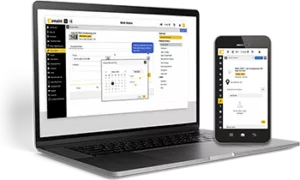
A computerized maintenance management system, or CMMS, can help your team manage these improvements by providing maintenance scheduling, inventory management, and workflows, and giving your team the tools they need to improve processes across your plant. To learn more about CMMS solutions, read our blog post or try a free demo of the award-winning eMaint CMMS.
Drawbacks of PFMEA
Maintenance teams sometimes overlook PFMEA or dismiss it as an administrative process. That’s a misunderstanding of the PFMEA meaning. Done right, PFMEA is one of the most valuable maintenance metrics around. However, getting it right means overcoming its built-in challenges. Here are some of the typical drawbacks of PFMEA.
Time and Resource Intensive: PFMEA requires in-depth analysis and documentation. Ideally, it should be performed at regular intervals; this can feel like a considerable burden, especially for lean maintenance teams.
Requires Significant Data: PFMEA assessments need high-quality data to be accurate. The PFMEA example worksheet asks for historical data, asset failure modes, maintenance records, and more. Depending on your maintenance program, you may not have access to all that data.
Potentially Subjective: Depending on how you implement it, PFMEA can be subjective — heavily based on the hunches and theories of your maintenance crew. That subjectivity might lead to inaccurate results and missed failure modes, and it might be why some teams prefer FMEA vs PFMEA.
Establishing a strong single source of maintenance data will correct most of the above challenges. With the right data, PFMEA is a reliable and valuable maintenance metric — and your CMMS can help.
Your CMMS acts as a central repository for work order histories, condition monitoring data, and other key information necessary to calculate PFMEA correctly. Beyond that, a CMMS makes it easier to calculate a range of maintenance metrics, so you have a full picture of facility-wide asset health.
How To Run PFMEA: A Step-by-Step Guide
PFMEA works by analyzing at each process and determining how it could go wrong. Those working on the PFMEA will name all the effects that could occur if that failure happens. For each process, the failures are ranked on:
- Severity – The impact of the failure, with 1 being least impactful and 10 being most impactful
- Occurrence – The likelihood of the failure happening, with 1 being very unlikely and 10 being highly likely or certain
- Detection – The chance that the failure will be detected, with 1 being easily detected and 10 being extremely difficult to detect
Usually, the PFMEA is completed in a spreadsheet. Then, the three numbers are multiplied together to produce a risk priority number (RPN):
RPN = Gravedad x Ocurrencia x Detección
Once the potential failures have been discovered and their severity ranked, the process of failure mitigation can begin. Often, it makes the most sense to try to avoid or reduce the risks for the higher RPN numbers first. In a PFMEA for manufacturing companies, the effects can include anything from inability to manufacture, slowed manufacturing, inability to meet production goals, end-user dissatisfaction, and everything in between.
PFMEA follows a structured methodology to systematically identify and address potential failures in a process. Here’s how to conduct a PFMEA in eight stages:
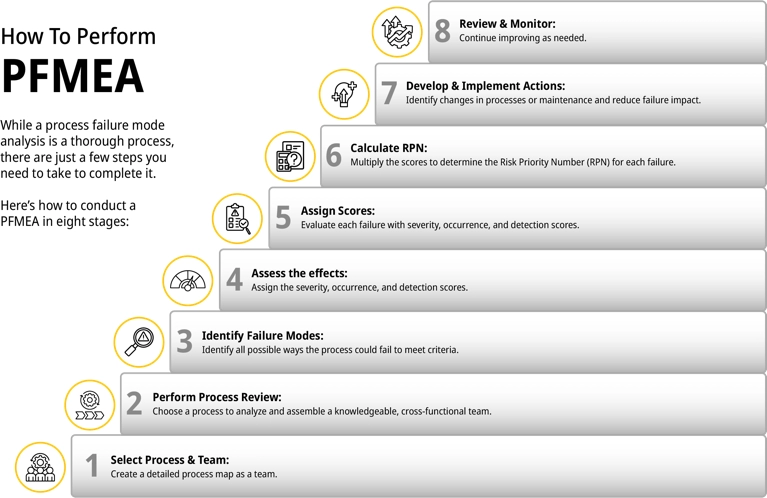
Step 1: Choose a Process and Assemble a Cross-Functional Team
Select a process to analyze, and with it, a cross-functional team of people involved in that process. The team members should be knowledgeable enough to give insightful input. They should have access to historical data and hands-on experience that can assist with completing the PFMEA.
Step 2: Map Out the Process in Question
As a team, perform a process review. Start by mapping out the entire process, breaking it down into individual steps or operations. This provides a clear understanding of the process flow and highlights critical points where failures could occur.
Paso 3: Identificar posibles modos de fallo
Para cada paso del proceso, identifique todas las formas posibles de que el proceso no cumpla las especificaciones o los criterios de rendimiento.
- Ejemplo: En un proceso de pintura, un modo de fallo podría ser una adherencia inadecuada de la pintura debido a la contaminación de la superficie.
Paso 4: Evaluar los efectos de los fallos
Determinar los efectos potenciales de cada modo de fallo sobre el proceso y el producto final. Considere el impacto en la calidad, la seguridad, el rendimiento y la satisfacción del cliente.
- Ejemplo: Una mala adherencia de la pintura puede provocar el rechazo del producto, el aumento de los costes de reprocesado y la insatisfacción del cliente.
Step 5: Assign Severity, Occurrence, and Detection Rankings
Califique cada modo de fallo en función de su gravedad (impacto), ocurrencia (probabilidad) y detección (capacidad de detectarlo antes de que llegue al cliente).
- Ejemplo: Un modo de fallo con alta gravedad, alta ocurrencia y baja detección sería priorizado para acciones correctivas.
Paso 6: Calcular el número de prioridad del riesgo (RPN)
Calculate the RPN by multiplying the severity, occurrence, and detection ratings. Calculate the RPN by multiplying the severity, occurrence, and detection rankings. This numerical value helps prioritize which failure modes need the most attention.
- Ejemplo: Si un modo de fallo tiene un índice de gravedad de 8, un índice de ocurrencia de 6 y un índice de detección de 3, el RPN sería 144 (8 x 6 x 3).
Paso 7: Elaborar y aplicar medidas correctoras
Together, identify changes in processes, employee education, maintenance, or other areas that help address and reduce the likelihood and/or impact of the high-risk failure modes discovered. These actions could involve process redesign, additional controls, or enhanced testing procedures.
- Ejemplo: Para solucionar la adherencia deficiente de la pintura, las acciones podrían incluir la mejora de los procedimientos de limpieza de superficies o la aplicación de un proceso de inspección de calidad más sólido.
Paso 8: Revisión y seguimiento
Revisar continuamente los resultados del PFMEA y controlar la eficacia de las acciones implementadas. Actualice el PFMEA según sea necesario para reflejar los cambios en el proceso o los nuevos modos de fallo.
- Beneficio: Garantiza que el PFMEA siga siendo pertinente y eficaz para prevenir fallos a lo largo del tiempo.
Siguiendo estos pasos, las organizaciones pueden aplicar eficazmente el PFMEA para identificar y mitigar los riesgos en sus procesos, mejorando la fiabilidad y la calidad generales.

PFMEA Risk Evaluation and Mitigation Strategies
What strategies and techniques can you use during the PFMEA process? Learn more about effective ways to carry out each stage of the PFMEA process.
Process Mapping Techniques: Process Flow Diagrams and PFMEA Worksheets
To illustrate each stage of your manufacturing processes, you can use a process flow diagram (PFD). It shows all inputs (raw materials, efforts, funds), outputs (end products), and stages (what your team and assets do) in detail.
PFDs are helpful because they make it easy to see every component of your process at a glance. And that’s critical when identifying risks in the next stages of the PFMEA process.
Next, PFMEA worksheets guide you through the remaining steps of the process. For each process step, you’ll assess potential failure modes, effects, causes and contributing factors, current actions, RPN, and recommended actions. The more comprehensive your worksheet, the more strategic your solutions can be.
Root Cause Analysis: Techniques To Identify Failure Modes
Root cause analysis (RCA) is the overarching process of exploring failures by defining the problem, gathering data, identifying contributing factors, identifying the cause, implementing the right corrective actions, and monitoring for improvements. Here are some popular techniques to perform RCA.
Fault Tree Analysis
Fault tree analysis is a visual tree-inspired map of the relationships that can lead to potential system failure. Start with your failure event at the top of the tree and add branches for each potential cause and contributing factor. Create sub-branches for related factors and new branches for unrelated ones. This in-depth failure analysis is helpful for complex and high-risk failures.
Cause-and-Effect Diagrams
Cause-and-effect diagrams such as fishbone diagrams, also known as Ishikawa diagrams, are another visual representation of potential failure modes. Similar to fault-tree analysis, these diagrams place potential failures at one end of the diagram as a fish head, then build out a skeleton of fish bones for related causes.
The Five Whys
The Five Whys or 5Y method lets teams get to the root of potential failure modes through inquisitive questioning. Start with the most obvious layer, then continue to ask, “Why?” For example:
The machine failed unexpectedly.
Why? The bearings on the asset wore out prematurely.
Why? There wasn’t enough lubrication.
Why? Lubricant in the pump ran out.
Why? We missed the previous inspection and preventive actions.
Why? Emergency maintenance takes precedent, removing resources from preventive maintenance.
By continuing to ask “Why,” you’ll reach the root of the problem. That way, you’ll strategically implement the right solution.
Techniques To Interpret RPN Values
Once you’ve calculated RPNs, you must decide on your thresholds for prioritization. This essential step lets you assess the importance of resolving each potential failure mode relative to other potential failures.
Higher RPNs represent higher potential risk, but what is “high”? This depends on several factors, including:
- Industria
- Risk tolerance
- Key performance indicators (KPIs)
- Budgets
- Recursos
Use your collective RPN data to design the right thresholds. You’ll typically categorize RPNs as high risk, moderate risk, and low risk. But, as you might imagine, categorizing 90% of your failure modes as “high risk” doesn’t help you prioritize. So, choose RPN thresholds that prioritize the most critical failure modes while leaving room to deprioritize lower-risk issues.
Techniques To Determine the Right Corrective Actions
Next, you must assign the appropriate corrective actions for each failure. Weigh possible actions with respect to feasibility, efficiency, cost, and effectiveness.
In other words, the right solution is one that you can implement realistically, quickly, and at a reasonable cost relative to the potential cost of failure. Finally, it should also resolve the issue as completely as possible, without additional measures.
5 Common Mistakes in PFMEA Analysis
Done right, PFMEA can save organizations substantial time, money, and effort. But to reap the benefits, you must avoid these common mistakes:
- Oversimplification. Simply going through the motions isn’t enough to gain substantial insights or drive noticeable change. Your entire team must be on board and committed to the process.
- Lack of communication. Cross-functional collaboration is particularly essential to identify causes and select appropriate corrective actions. Equipment operators don’t have the same insights that engineers do, and vice-versa. To understand problems and implement effective solutions, teams must communicate and work together.
- Outdated or siloed documentation. Paper records make interdepartmental communication more difficult. It’s also much more challenging to adopt a continuous improvement approach to PFMEA without dynamic records and trending data analysis. Use the right tools, such as CMMS, to improve documentation and communication.
- Poor risk assessment and prioritization. Improperly ranking or prioritizing potential failures invalidates everything you could stand to gain from PFMEA. Full team buy-in, dedication, and cross-functional collaboration can prevent you from making this mistake.
- Ineffective monitoring and improvement strategies. PFMEA isn’t a one-time process. To properly eliminate failure modes that cost you time and money, it’s essential to develop robust plans, carefully monitor your updates, and adjust your approach.
Best Practices for PFMEA Implementation
PFMEA should be a part of your team’s larger quality management systems. To implement this process efficiently and effectively, take the following measures.
Within your team, clearly communicate and document which team members are part of the process and what they’re responsible for.
Within your processes, establish clear scenarios signaling the need for PFMEA — for example, when new quality issues arise or processes change. Also, create standardized documentation (workflows, checklists, etc.) to simplify the process, as well as a system to track and monitor improvements.
Finally, within your broader plant management strategy, use PFMEA as one tool for problem solving — but emphasize preventive strategies for operational excellence. Other quality solutions such as statistical process control (SPC) can help you control, monitor, and improve production.
How eMaint Supports PFMEA Management
eMaint is the best CMMS software according to reviews from its 150,000 users across G2, Capterra, and Gartner. Customers say eMaint is ideal for frontline teams needing fast setup, mobile workflows, and simplicity.
eMaint G2 Comentarios de los clientes
“eMaint has been a great system to use. Very user friendly and the support teams are amazing!” – Lisa T., Field Service Engineer. ★★★★★ -> Read Review
“Hands down, the best CMMS I have ever used or seen.” – Michael R., Maintenance Supervisor. ★★★★★ -> Read Review
“Simply the best CMMS.” – Carlos M, Preventive Maintenance Coordinator. ★★★★★ -> Read Review
Por qué los expertos llaman a eMaint el mejor software GMAO y EAM
eMaint Is a Mobile-First CMMS
eMaint es un GMAO moderno y móvil que ofrece simplicidad, facilidad de uso y colaboración en tiempo real para los trabajadores de mantenimiento de primera línea.
eMaint Is Easy To Use
A los equipos de mantenimiento les encanta la sencillez y la interfaz intuitiva y fácil de usar que ofrece eMaint, lo que permite a los trabajadores aprender rápidamente a ahorrar tiempo y reducir costes con el software.
eMaint Simplifies Implementation and Deployment
eMaint se especializa en implementaciones rápidas que ponen a los equipos al día rápidamente y maximizan el retorno de la inversión a largo plazo. Los equipos confían en Fluke para obtener el estándar de oro en atención al cliente.
eMaint Is the Leader in Industrial AI Thanks to Fluke Innovation
eMaint forma parte del ecosistema de IA de Fluke, que incluye un asistente de IA eMaint, mantenimiento predictivo impulsado por IA, previsión de inventario de piezas con IA y mucho más.