
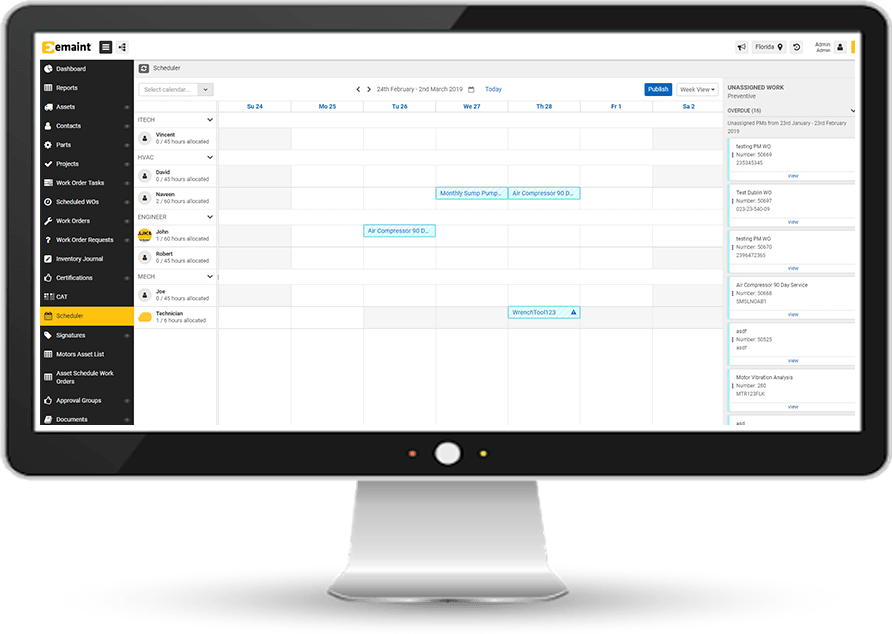
¿Qué es el mantenimiento programado?
Scheduled maintenance is any planned repair or service task performed within a specified timeframe. This includes routine inspections, adjustments, and regular service, as well as planned shutdowns. Scheduled maintenance can be recurring, performed at regular intervals, or triggered by a specific work request. It is designed to proactively address potential issues, ensuring efficient and timely upkeep of equipment and systems.
Completing tasks is only part of scheduled maintenance. Who finishes the task, where it takes place, and how long it takes are all crucial parts of the maintenance schedule. Even if you know which assets require repairs, you still need to pick the ideal person for the job and the optimal time to do it. Without proper organization, keeping track of everything can be a headache. That is why optimized scheduled maintenance requires a CMMS, or computerized maintenance management system, to help manage work orders, assets, maintenance tasks, and more.
¿Qué es la diferencia entre mantenimiento planificado y mantenimiento programado?
The terms planned maintenance and scheduled maintenance are often used interchangeably, but they are separate examples of preventive maintenance. A comprehensive asset maintenance strategy requires planned and scheduled maintenance working in tandem.
El mantenimiento planificado es el proceso de prever o anticipar las necesidades de mantenimiento de los activos y planificar estratégicamente el mantenimiento futuro. El mantenimiento planificado es un término global que engloba el mantenimiento preventivo, el mantenimiento predictivo y las estrategias de mantenimiento basadas en la condición.
Scheduled maintenance is the process of determining who should complete maintenance tasks and when they should be completed. Rather than forecasting future maintenance needs, scheduled maintenance focuses on resolving issues that have already been identified, assigning a worker to the task, and setting a deadline for task completion.
What Are the 4 Types of Maintenance?
Scheduled maintenance is a crucial component of effective asset management, ensuring equipment reliability and operational efficiency. There are several core types of scheduled maintenance, each serving a unique purpose in maintaining equipment health and changing the way tasks are scheduled.
Understanding these types of maintenance helps organizations implement a tailored maintenance strategy that optimizes equipment performance and reduces cost. It allows them to schedule maintenance that meets the precise needs of the operation, all without wasting time scheduling unnecessary tasks or last-minute repairs after downtime has derailed operations.
Here are the four types of maintenance:
Mantenimiento en función del tiempo
Maintenance activities are scheduled at regular, predefined intervals (e.g., weekly, monthly, quarterly). An example of this would be regular oil changes in machinery every three months to ensure optimal performance. Time-based maintenance removes guess work from maintenance scheduling. Completion dates for tasks are set; then, a schedule can be built around them. This type of maintenance prevents unexpected breakdowns and prolongs equipment lifespan.
Mantenimiento basado en el uso
With this maintenance type, tasks are triggered based on usage metrics (e.g., operating hours, production cycles). For example, replacing HVAC system filters after 1,000 hours of operation. Usage-based maintenance requires a bit more data than time-based maintenance, as the usage of each individual asset must be closely monitored. This makes scheduling more efficient by aligning maintenance activities with actual equipment usage, reducing unnecessary maintenance.
Mantenimiento predictivo (PdM)
Predictive maintenance uses real-time data and advanced analytics to predict when maintenance should be performed. An example of this would be performing vibration analysis on rotating equipment to detect early signs of wear and schedule maintenance before failure occurs. More recently, AI has been integrated to further enhance insight quality. Scheduling with a predictive model minimizes downtime and maximizes asset availability by addressing issues before they escalate.
Mantenimiento basado en el estado (CBM)
Maintenance is performed based on the actual condition of the equipment, often monitored with sensors and diagnostic tools. An example of this would be only performing maintenance on a generator when data indicates it’s operating outside of normal parameters. This allows scheduling to focus resources on equipment that truly needs attention and reduces time spent working on machines that have no irregularities.

Industries That Rely on Scheduled Maintenance
Transporte
Scheduled maintenance keeps workers on the road and cars out of the garage. When vehicles get regularly scheduled oil changes and tune ups, they are less likely to break down. In turn, transportation companies can complete more work orders, improve vehicle reliability, and slash emergency maintenance costs.
Manufactura
The majority of manufacturing plants schedule maintenance ahead of time. Scheduled maintenance helps keep assets in good working order, which reduces interruptions to operations and keeps production consistent.
Atención médica
In addition to essential medical devices, healthcare facilities have numerous assets like lighting, HVAC systems, and water heaters to maintain. Proactive scheduled maintenance is necessary to keep these crucial systems in optimal condition.
¿Qué es el Mantenimiento Programado de Fábrica?
El mantenimiento programado de fábrica -una forma de mantenimiento en función del tiempo- es un buen ejemplo de mantenimiento programado recurrente. Consiste en comprobar la existencia de posibles problemas mientras se realiza el mantenimiento rutinario a intervalos fijos. La mayoría de los vehículos de consumo requieren revisiones a intervalos de kilometraje establecidos para que sigan funcionando según las especificaciones del fabricante y mantener activas las garantías. Del mismo modo, cada pieza de equipo vendrá con un programa de mantenimiento recomendado por el fabricante.
While forgoing factory scheduled maintenance may seem like an opportunity to reduce expenses, routine maintenance inspections can be essential to finding and resolving problems early. As a result, keeping assets up to date with factory-recommended maintenance may reduce costs in the long run. (Of course, condition-based maintenance may be an even better approach if properly implemented.)
¿Cuáles son los Beneficios del mantenimiento programado?
El mantenimiento programado garantiza un rendimiento fiable de los activos y reduce los tiempos de inactividad imprevistos al mantener los equipos en buenas condiciones de funcionamiento. También le ayuda a identificar los problemas antes de que se conviertan en averías o paradas. Un mantenimiento programado adecuado prolonga la vida útil de los activos y mantiene activas las garantías. Todas estas tareas pueden realizarse fácilmente con un buen software de programación del mantenimiento.
La implementación de un programa de mantenimiento programado ofrece numerosas ventajas que mejoran la eficiencia y la longevidad de los equipos y sistemas. He aquí los principales Beneficios:
Mejora de la fiabilidad de los equipos
Regular maintenance ensures that equipment operates at peak performance, reducing the likelihood of unexpected breakdowns. Routine inspection and servicing of machinery prevents sudden failures that could disrupt production.
Mayor vida útil de los activos
El mantenimiento programado prolonga la vida útil de los equipos y reduce la necesidad de sustituciones prematuras. La lubricación periódica y la sustitución de piezas hacen que las máquinas funcionen sin problemas, alargando su vida útil.
Less Unplanned Downtime
El mantenimiento programado minimiza los tiempos de inactividad imprevistos al abordar de forma proactiva los posibles problemas antes de que provoquen averías. Una planta de fabricación que sigue un estricto programa de mantenimiento experimenta menos paradas de producción debidas a averías de los equipos.
Ahorro de costes
El mantenimiento preventivo rutinario puede ahorrar dinero al evitar costosas reparaciones de emergencia y reducir la frecuencia de las revisiones importantes. Realizar un mantenimiento programado de los sistemas de calefacción, ventilación y aire acondicionado evita costosas averías y alarga el tiempo entre reformas importantes.
Mayor seguridad
El mantenimiento periódico garantiza que los equipos funcionen de forma segura, reduciendo el riesgo de accidentes y lesiones. Las comprobaciones periódicas de los sistemas de seguridad de la maquinaria industrial garantizan el funcionamiento de todas las medidas de protección y evitan accidentes laborales.
Cumplimiento de la normativa
Scheduled maintenance helps organizations comply with industry regulations and standards, avoiding penalties and ensuring safe operations. This is especially important for strictly regulated medical device manufacturing assets. Adhering to maintenance schedules ensures proper compliance.
Mejora de la eficiencia
Los equipos bien mantenidos funcionan de forma más eficiente, reduciendo el consumo de energía y mejorando la productividad global. El mantenimiento periódico de las máquinas de las líneas de producción garantiza su funcionamiento eficiente, reduciendo los costes energéticos y aumentando la producción.
Mejor gestión de los recursos
El mantenimiento programado permite planificar y asignar mejor los recursos de mantenimiento, optimizando la mano de obra y el inventario de piezas. El uso del software GMAO para planificar las tareas de mantenimiento garantiza que los técnicos y las piezas estén disponibles cuando se necesiten, lo que reduce el tiempo de inactividad.
Detección precoz de problemas
Las inspecciones y revisiones rutinarias ayudan a detectar posibles problemas a tiempo, antes de que se conviertan en problemas graves. Las revisiones periódicas de los equipos de las instalaciones pueden detectar fugas o puntos débiles antes de que causen daños importantes.

¿Qué es un ejemplo de programación del mantenimiento?
Scheduled maintenance can be seen throughout any typical manufacturing facility or factory floor. Take a conveyor belt as a potential example. The belt and bearings slowly wear out over time, and routine maintenance is necessary to prevent any negative effect on performance.
The required service can be as simple as checking belt alignment or as complex as completely replacing bearings at set intervals. Regardless of the maintenance task, it always needs to be scheduled. When building the schedule, the maintenance planner must take several factors into account — the task priority level, technician availability, and existing scheduled maintenance.
If the schedule is designed around time-based maintenance and the required task is routine, this process will be more rigid. There is already a predetermined time when maintenance needs to be completed. The exact time just depends on a technician’s availability. If there is a bigger problem with the belt, or monitoring indicates a check is needed, then the speed at which the task can be completed will depend on existing scheduled tasks. Once that’s determined, a work order will be created, and the maintenance will officially be scheduled.
Duplique este proceso docenas o cientos de veces, dependiendo del tamaño de la organización, y tendrá una buena idea de la complejidad del mantenimiento programado.
¿Qué es la SMCP?
El porcentaje crítico de mantenimiento programado (SMCP) es una métrica utilizada para priorizar las tareas de mantenimiento, especialmente cuando hay varias tareas atrasadas. El SMCP calcula el número de días de retraso de una tarea de mantenimiento en relación con la frecuencia con la que está programada. El número resultante se expresa en porcentaje. Cuanto más alto sea el porcentaje, más alta deberá ser la tarea en su lista de prioridades de mantenimiento para lograr la máxima eficacia.
Cómo calcular el SMCP
The formula for SMCP is fairly simple. Start by adding the number of days late a task (or PM) is to the number of days in a maintenance cycle. Then, divide the sum by the number of days in the maintenance cycle and multiply that result by 100.
(nº de días de retraso + nº de días del ciclo PM) ÷ nº de días del ciclo PM x 100 = SMCP
This provides you with a percentage that expresses exactly how to prioritize a list of overdue tasks. It can then be used to more efficiently allocate resources, saving you time and money.
Scheduled Maintenance Critical Percent (SMCP) Example
¿Cómo se ve la SMCP en acción? Consideremos un sistema en el que varias tareas de mantenimiento están atrasadas. La tarea 1 suele completarse cada 45 días y ahora lleva 4 días de retraso. Mientras tanto, otra tarea se completa cada 30 días y ahora lleva 3 días de retraso. La tarea 3 tiene un ciclo de 90 días y lleva 7 días de retraso.
¿Qué tarea debe realizar primero su equipo de mantenimiento? A primera vista, puede parecer lógico abordar primero la tarea más atrasada, pero no siempre es la mejor opción.
Apliquemos un cálculo rápido de la SMCP para averiguarlo:
Tarea nº 1: (4+45) ÷ 45 x 100 = 109%.
Tarea nº 2: (3+30) ÷ 30 x 100 = 110%.
Tarea nº 3: (7+90) ÷ 30 x 100 = 108%.
Based on SMCP, Task 2 has the highest percentage and should be prioritized ahead of Tasks 1 and 3, even though those tasks are more days overdue. Since Task 2 has the shortest maintenance cycle, three days of overdue maintenance has a larger impact on the machine than the longer day counts seen with the other tasks.
Benefits of Tracking SMCP
There are four key benefits to tracking SMCP:
- Improve efficiency: Your scheduled maintenance critical percentage helps you prioritize tasks based on how far you’ve departed from your regular schedule.
- Reduce reactive maintenance: With an effective system to catch up on backlogged tasks, you can spot more potential failures before they become urgent. This leads to more uptime and improved safety.
- Reduce costly downtime: SMCP helps prioritize your most overdue maintenance tasks, which lowers the risk of equipment failure. That cuts unexpected downtime, which reduces costs thanks to increased productivity, decreased emergency maintenance, and prolonged asset life.
- Simplify audits: Reducing your backlog helps you remedy potential compliance issues before audits occur.
Tracking SMCP simplifies scheduling while reducing costs associated with reactive maintenance practices, unexpected downtime, and compliance violations.
Cómo crear un programa de mantenimiento
Al integrar el mantenimiento programado en su estrategia de mantenimiento, puede garantizar que sus activos sigan siendo fiables, eficientes y seguros. Sin embargo, tiene que asegurarse de crear su programa correctamente para cosechar los Beneficios. Estos son los pasos para crear un programa de mantenimiento:
Determine sus necesidades de activos y elabore un plan
Before scheduling can begin, you need to know your exact requirements. Take stock of all assets in the facility, their required maintenance cadences, and build out a rough plan of how to handle them. You should also know how many maintenance technicians are on site and what their availability looks like. All the prep work that goes into this stage of the process will make all other steps much easier.
Implantar una plataforma
Gone are the days of paper work orders and manual documentation. A modern maintenance schedule requires some level of digital integration with a scheduling tool. Leveraging a CMMS can streamline your scheduled maintenance processes, making it easier to reap the advantages. Make sure to get a scheduling platform that fits the size of your operation and has all the functions you will need to maintain your assets.
Priorizar tareas
A continuación, es el momento de priorizar los activos de misión crítica y construir un esqueleto de su calendario. Esto garantiza que el mantenimiento se centre en las áreas más importantes y resulta extremadamente útil si los recursos son limitados.
Programar tareas y establecer seguimientos
Once assets have been identified and ranked, it is time to start scheduling. Schedule out maintenance tasks in order of importance and as efficiently as possible. It’s impossible to have a perfect schedule, but you should strive to avoid disruptions and minimize downtime. Once an initial round of maintenance has been completed, build in automatic triggers to reschedule routine maintenance at the appropriate cadence.
Ajustar y optimizar
Even after a schedule is made, it is never set in stone. Even with your best efforts, failures will still happen, and high-priority maintenance will have to be scheduled. Create your schedule with this in mind, leaving some flexibility for on-the-fly adjustments. Once maintenance tasks are in full swing, take note of what’s working and what might be causing bottlenecks. Always observe and optimize the schedule as needed.
How to Write Scheduled Maintenance Messages
All parties throughout your organization must have access to relevant information for scheduled maintenance tasks. The best way to do that? Clear and concise maintenance messages. Follow these best practices for effective work orders and communications:
- Provide ample notice for all requested work. With the exception of corrective and emergency maintenance, you should schedule all maintenance efforts well in advance by several days, if not weeks or months. This allows ample time to order necessary inventory and plan for downtime.
- Consider widespread impact. Beyond the maintenance professionals performing the work, who else will feel the impact of these scheduled maintenance activities? Consider affected staff and processes across production, warehouse, office, and beyond — then tailor your communications to each group.
- Include all relevant details. If your work order requires follow-up questions, it’s not comprehensive enough. Include assigned resources, dates and time estimates, description of the work, location, and necessary tools and parts.
- Communicate effectively. Use standardized operating procedures (SOPs) to establish the right communication channels for each type of maintenance. In addition to updating your computerized maintenance management system (CMMS), you may also wish to send emails, hold meetings, or publish updates on an intranet system.
A successful scheduled maintenance program includes consideration for all parties and facilities. Timely, detailed communication is the best way forward.
Implemente un GMAO para impulsar su mantenimiento programado
A comprehensive maintenance strategy ensures asset reliability and performance and keeps your operations running smoothly. Using a CMMS like eMaint to incorporate scheduled maintenance into your maintenance strategy — along with other proactive measures like real-time condition monitoring and predictive maintenance— will help prevent shutdowns and unexpected maintenance costs.
Mantenimiento programado FAQS
¿Qué es el mantenimiento programado?
El mantenimiento programado es la asignación de tareas de mantenimiento a un técnico dentro de un plazo determinado. Puede tratarse de una comprobación rutinaria con una cadencia establecida o de un servicio de última hora necesario para evitar el tiempo de inactividad de la máquina.
¿Por qué es importante el mantenimiento programado?
El mantenimiento programado es importante porque garantiza el cuidado adecuado de la maquinaria, mejorando la eficiencia operativa y la vida útil de los activos. Algunos de los Beneficios del mantenimiento programado son la mejora de la fiabilidad de los equipos, la reducción de los tiempos de inactividad imprevistos, la mejora de la seguridad, la reducción de los costes de mantenimiento y una mejor gestión de los recursos.
What Does a Maintenance Scheduler Do?
A maintenance scheduler reviews maintenance requirements, capacity, resources, and inventory to schedule maintenance tasks and manage resource allocation accordingly.
Depending on the size of your company’s operations, a maintenance scheduler may be a person (such as a maintenance manager) or a software system. As you scale, the automation and data analysis features afforded by enterprise asset management (EAM) tools and computerized maintenance management systems will become critical to your maintenance scheduling process.
¿Con qué frecuencia debe programarse el mantenimiento?
El mantenimiento debe programarse en función de las instrucciones del fabricante, la disponibilidad del técnico y las normas de la organización. La cadencia exacta del mantenimiento dependerá de la máquina a la que se preste servicio, de sus pautas de uso y del entorno en el que se encuentre. En última instancia, el mantenimiento puede incluso tener que programarse de forma reactiva debido a un mal funcionamiento del equipo.
How Can I Implement an Effective Scheduled Maintenance Program?
To implement an effective scheduled maintenance program, follow these steps:
- Take inventory of all assets
- Determine requirements for each asset using manufacturer guidelines and your data
- Implement a CMMS
- Train staff
- Prioritize tasks
- Document standard operating procedures
- Issue work orders
- Perform scheduled maintenance, including regular inspections
- Track completed tasks
- Measure impact using comprehensive reporting tools from your CMMS
- Adopt a continuous improvement approach
This process starts with data-driven decision-making and aims to establish standardized processes. But it’s not rigid — built-in adaptability helps you consider new information and improve along the way.