
Was ist planmäßige Wartung?
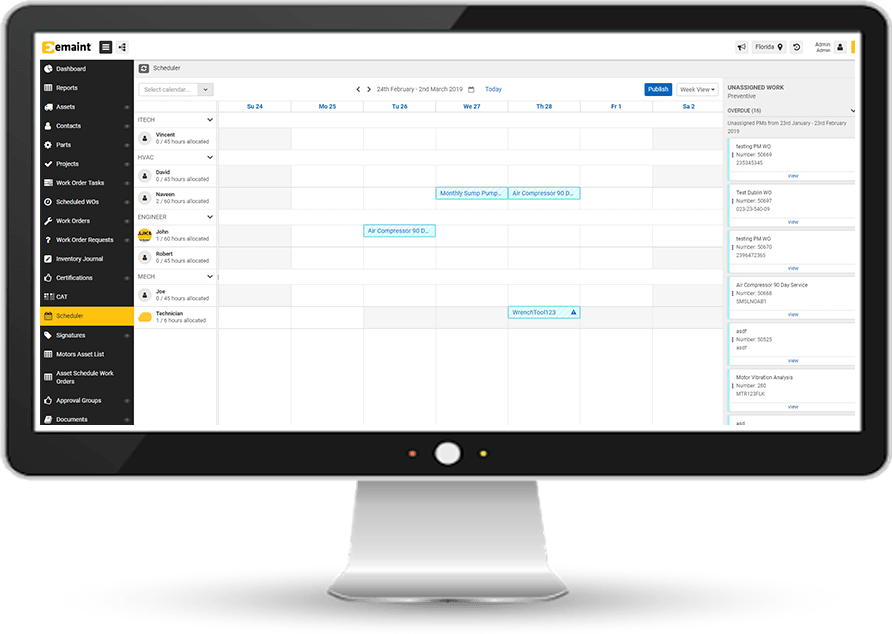
Scheduled maintenance is any planned repair or service task performed within a specified timeframe. This includes routine inspections, adjustments, and regular service, as well as planned shutdowns. Scheduled maintenance can be recurring, performed at regular intervals, or triggered by a specific work request. It is designed to proactively address potential issues, ensuring efficient and timely upkeep of equipment and systems.
Completing tasks is only part of scheduled maintenance. Who finishes the task, where it takes place, and how long it takes are all crucial parts of the maintenance schedule. Even if you know which assets require repairs, you still need to pick the ideal person for the job and the optimal time to do it. Without proper organization, keeping track of everything can be a headache. That is why optimized scheduled maintenance requires a CMMS, or computerized maintenance management system, to help manage work orders, assets, maintenance tasks, and more.
Was ist der Unterschied zwischen geplanter Wartung und planmäßiger Wartung?
The terms planned maintenance and scheduled maintenance are often used interchangeably, but they are separate examples of preventive maintenance. A comprehensive asset maintenance strategy requires planned and scheduled maintenance working in tandem.
Unter geplanter Instandhaltung versteht man den Prozess der Vorhersage oder Antizipation des Instandhaltungsbedarfs von Anlagen und die strategische Planung künftiger Instandhaltung. Geplante Instandhaltung ist ein übergreifender Begriff, der vorbeugende Instandhaltung, vorausschauende Instandhaltung und zustandsorientierte Instandhaltungsstrategien umfasst.
Scheduled maintenance is the process of determining who should complete maintenance tasks and when they should be completed. Rather than forecasting future maintenance needs, scheduled maintenance focuses on resolving issues that have already been identified, assigning a worker to the task, and setting a deadline for task completion.
What Are the 4 Types of Maintenance?
Scheduled maintenance is a crucial component of effective asset management, ensuring equipment reliability and operational efficiency. There are several core types of scheduled maintenance, each serving a unique purpose in maintaining equipment health and changing the way tasks are scheduled.
Understanding these types of maintenance helps organizations implement a tailored maintenance strategy that optimizes equipment performance and reduces cost. It allows them to schedule maintenance that meets the precise needs of the operation, all without wasting time scheduling unnecessary tasks or last-minute repairs after downtime has derailed operations.
Here are the four types of maintenance:
Zeitabhängige Wartung
Maintenance activities are scheduled at regular, predefined intervals (e.g., weekly, monthly, quarterly). An example of this would be regular oil changes in machinery every three months to ensure optimal performance. Time-based maintenance removes guess work from maintenance scheduling. Completion dates for tasks are set; then, a schedule can be built around them. This type of maintenance prevents unexpected breakdowns and prolongs equipment lifespan.
Nutzungsabhängige Wartung
With this maintenance type, tasks are triggered based on usage metrics (e.g., operating hours, production cycles). For example, replacing HVAC system filters after 1,000 hours of operation. Usage-based maintenance requires a bit more data than time-based maintenance, as the usage of each individual asset must be closely monitored. This makes scheduling more efficient by aligning maintenance activities with actual equipment usage, reducing unnecessary maintenance.
Vorausschauende Instandhaltung (PdM)
Predictive maintenance uses real-time data and advanced analytics to predict when maintenance should be performed. An example of this would be performing vibration analysis on rotating equipment to detect early signs of wear and schedule maintenance before failure occurs. More recently, AI has been integrated to further enhance insight quality. Scheduling with a predictive model minimizes downtime and maximizes asset availability by addressing issues before they escalate.
Zustandsabhängige Instandhaltung (CBM)
Maintenance is performed based on the actual condition of the equipment, often monitored with sensors and diagnostic tools. An example of this would be only performing maintenance on a generator when data indicates it’s operating outside of normal parameters. This allows scheduling to focus resources on equipment that truly needs attention and reduces time spent working on machines that have no irregularities.

Industries That Rely on Scheduled Maintenance
Transport
Scheduled maintenance keeps workers on the road and cars out of the garage. When vehicles get regularly scheduled oil changes and tune ups, they are less likely to break down. In turn, transportation companies can complete more work orders, improve vehicle reliability, and slash emergency maintenance costs.
Herstellung
The majority of manufacturing plants schedule maintenance ahead of time. Scheduled maintenance helps keep assets in good working order, which reduces interruptions to operations and keeps production consistent.
Gesundheitswesen
In addition to essential medical devices, healthcare facilities have numerous assets like lighting, HVAC systems, and water heaters to maintain. Proactive scheduled maintenance is necessary to keep these crucial systems in optimal condition.
Was ist werkseitige planmäßige Wartung?
Die werkseitige planmäßige Wartung - eine Form der zeitabhängigen Wartung - ist ein gutes Beispiel für eine wiederkehrende planmäßige Wartung. Sie umfasst die Überprüfung auf potenzielle Probleme und die Durchführung von Routinewartungen in festgelegten Intervallen. Die meisten Privatfahrzeuge müssen in bestimmten Zeitabständen gewartet werden, damit sie den Spezifikationen des Herstellers entsprechen und die Garantie erhalten bleibt. In ähnlicher Weise wird jedes Gerät mit einem vom Hersteller empfohlenen Wartungsplan geliefert.
While forgoing factory scheduled maintenance may seem like an opportunity to reduce expenses, routine maintenance inspections can be essential to finding and resolving problems early. As a result, keeping assets up to date with factory-recommended maintenance may reduce costs in the long run. (Of course, condition-based maintenance may be an even better approach if properly implemented.)
Was sind die Vorteile einer planmäßigen Wartung?
Eine planmäßige Wartung gewährleistet eine zuverlässige Leistung der Anlagen und reduziert ungeplante Ausfallzeiten, indem sie die Geräte in einem guten Betriebszustand hält. Außerdem hilft sie Ihnen, Probleme zu erkennen, bevor sie zu Ausfällen oder Stillständen führen. Eine ordnungsgemäße planmäßige Wartung verlängert die Lebensdauer von Anlagen und hält Ihre Garantien aufrecht. All diese Aufgaben lassen sich mit einer leistungsfähigen Software für die Wartungsplanung leicht durchführen.
Die Einführung eines planmäßigen Wartungsprogramms bietet zahlreiche Vorteile, die die Effizienz und Langlebigkeit von Geräten und Systemen erhöhen. Hier sind die wichtigsten Vorteile:
Verbesserte Ausrüstungszuverlässigkeit
Regular maintenance ensures that equipment operates at peak performance, reducing the likelihood of unexpected breakdowns. Routine inspection and servicing of machinery prevents sudden failures that could disrupt production.
Verlängerte Lebensdauer der Anlagen
Durch die frühzeitige Behebung von Verschleißerscheinungen verlängert die planmäßige Wartung die Lebensdauer der Geräte und verringert die Notwendigkeit eines vorzeitigen Austauschs. Regelmäßige Schmierung und der Austausch von Teilen sorgen für einen reibungslosen Betrieb der Maschinen und verlängern ihre Nutzungsdauer.
Less Unplanned Downtime
Durch planmäßige Wartung werden unerwartete Ausfallzeiten minimiert, da potenzielle Probleme proaktiv angegangen werden, bevor sie zu Ausfällen führen. In einem Fertigungsbetrieb, der einen strengen Wartungsplan einhält, kommt es seltener zu Produktionsausfällen aufgrund von Fehlfunktionen der Anlagen.
Kosteneinsparungen
Mit einer routinemäßigen vorbeugenden Wartung kann Geld gespart werden, indem kostspielige Notreparaturen vermieden und die Häufigkeit größerer Überholungen verringert werden. Die planmäßige Wartung von HLK-Systemen verhindert kostspielige Ausfälle und verlängert die Zeit zwischen größeren Renovierungsarbeiten.
Erhöhte Sicherheit
Regelmäßige Wartung gewährleistet den sicheren Betrieb der Anlagen und verringert das Risiko von Unfällen und Verletzungen. Regelmäßige Überprüfungen der Sicherheitssysteme von Industriemaschinen gewährleisten, dass alle Schutzmaßnahmen funktionieren und Arbeitsunfälle vermieden werden.
Einhaltung von Vorschriften
Scheduled maintenance helps organizations comply with industry regulations and standards, avoiding penalties and ensuring safe operations. This is especially important for strictly regulated medical device manufacturing assets. Adhering to maintenance schedules ensures proper compliance.
Verbesserte Effizienz
Gut gewartete Anlagen arbeiten effizienter, senken den Energieverbrauch und steigern die Gesamtproduktivität. Die regelmäßige Wartung von Maschinen in Produktionslinien stellt sicher, dass sie effizient arbeiten, die Energiekosten senken und die Leistung steigern.
Bessere Ressourcenverwaltung
Eine planmäßige Wartung ermöglicht eine bessere Planung und Zuweisung von Wartungsressourcen und optimiert den Arbeits- und Teilebestand. Der Einsatz von CMMS-Software zur Planung von Wartungsaufgaben stellt sicher, dass Techniker und Ersatzteile bei Bedarf zur Verfügung stehen, wodurch Ausfallzeiten reduziert werden.
Frühzeitige Erkennung von Problemen
Regelmäßige Inspektionen und Wartungen helfen, potenzielle Probleme frühzeitig zu erkennen, bevor sie sich zu größeren Problemen auswachsen. Regelmäßige Überprüfungen der Anlagenausrüstung können Lecks oder Schwachstellen aufdecken, bevor sie größere Schäden verursachen.

Was ist ein Beispiel für eine Wartungsterminierung?
Scheduled maintenance can be seen throughout any typical manufacturing facility or factory floor. Take a conveyor belt as a potential example. The belt and bearings slowly wear out over time, and routine maintenance is necessary to prevent any negative effect on performance.
The required service can be as simple as checking belt alignment or as complex as completely replacing bearings at set intervals. Regardless of the maintenance task, it always needs to be scheduled. When building the schedule, the maintenance planner must take several factors into account — the task priority level, technician availability, and existing scheduled maintenance.
If the schedule is designed around time-based maintenance and the required task is routine, this process will be more rigid. There is already a predetermined time when maintenance needs to be completed. The exact time just depends on a technician’s availability. If there is a bigger problem with the belt, or monitoring indicates a check is needed, then the speed at which the task can be completed will depend on existing scheduled tasks. Once that’s determined, a work order will be created, and the maintenance will officially be scheduled.
Wenn Sie diesen Vorgang je nach Größe des Unternehmens dutzende oder hunderte Male wiederholen, erhalten Sie einen guten Eindruck von der Komplexität der geplanten Wartung.
Was ist SMCP?
SMCP (Scheduled Maintenance Critical Percentage) ist eine Kennzahl, die zur Priorisierung von Instandhaltungsmaßnahmen verwendet wird, insbesondere wenn mehrere Maßnahmen überfällig sind. SMCP berechnet die Anzahl der Tage, an denen eine Wartungsmaßnahme überfällig ist, im Verhältnis dazu, wie häufig die Wartungsmaßnahme eingeplant ist. Die resultierende Zahl wird als Prozentsatz ausgedrückt. Je höher der Prozentsatz, desto höher sollte diese Maßnahme auf Ihrer Prioritätenliste stehen, um maximale Effizienz zu erreichen.
So berechnen Sie das SMCP
The formula for SMCP is fairly simple. Start by adding the number of days late a task (or PM) is to the number of days in a maintenance cycle. Then, divide the sum by the number of days in the maintenance cycle and multiply that result by 100.
(Anzahl der verspäteten Tage + Anzahl der Tage im PM-Zyklus) ÷ Anzahl der Tage im PM-Zyklus x 100 = SMCP
This provides you with a percentage that expresses exactly how to prioritize a list of overdue tasks. It can then be used to more efficiently allocate resources, saving you time and money.
Scheduled Maintenance Critical Percent (SMCP) Example
Wie sieht SMCP in der Praxis aus? Betrachten wir ein System, in dem mehrere Wartungsaufgaben überfällig sind. Aufgabe 1 wird normalerweise alle 45 Tage erledigt und ist jetzt 4 Tage überfällig. In der Zwischenzeit wird eine andere Aufgabe alle 30 Tage erledigt und ist nun 3 Tage überfällig. Aufgabe 3 wird in einem 90-Tage-Zyklus erledigt und ist seit 7 Tagen überfällig.
Welche Aufgabe sollte Ihr Wartungsteam zuerst erledigen? Auf den ersten Blick mag es logisch erscheinen, die überfälligste Aufgabe zuerst in Angriff zu nehmen, aber das ist nicht immer die optimale Wahl.
Lassen Sie uns eine schnelle SMCP-Berechnung durchführen, um das herauszufinden:
Aufgabe 1: (4+45) ÷ 45 x 100 = 109%
Aufgabe #2: (3+30) ÷ 30 x 100 = 110%
Aufgabe Nr. 3: (7+90) ÷ 30 x 100 = 108%
Based on SMCP, Task 2 has the highest percentage and should be prioritized ahead of Tasks 1 and 3, even though those tasks are more days overdue. Since Task 2 has the shortest maintenance cycle, three days of overdue maintenance has a larger impact on the machine than the longer day counts seen with the other tasks.
Benefits of Tracking SMCP
There are four key benefits to tracking SMCP:
- Improve efficiency: Your scheduled maintenance critical percentage helps you prioritize tasks based on how far you’ve departed from your regular schedule.
- Reduce reactive maintenance: With an effective system to catch up on backlogged tasks, you can spot more potential failures before they become urgent. This leads to more uptime and improved safety.
- Reduce costly downtime: SMCP helps prioritize your most overdue maintenance tasks, which lowers the risk of equipment failure. That cuts unexpected downtime, which reduces costs thanks to increased productivity, decreased emergency maintenance, and prolonged asset life.
- Simplify audits: Reducing your backlog helps you remedy potential compliance issues before audits occur.
Tracking SMCP simplifies scheduling while reducing costs associated with reactive maintenance practices, unexpected downtime, and compliance violations.
Wie man einen Wartungsplan erstellt
Wenn Sie die planmäßige Wartung in Ihre Instandhaltungsstrategie integrieren, können Sie sicherstellen, dass Ihre Anlagen zuverlässig, effizient und sicher bleiben. Sie müssen jedoch sicherstellen, dass Sie Ihren Zeitplan richtig erstellen, um die Vorteile zu nutzen. Hier sind die Schritte zur Erstellung eines Wartungsplans:
Bestimmen Sie Ihre Vermögensanforderungen und erstellen Sie einen Plan
Before scheduling can begin, you need to know your exact requirements. Take stock of all assets in the facility, their required maintenance cadences, and build out a rough plan of how to handle them. You should also know how many maintenance technicians are on site and what their availability looks like. All the prep work that goes into this stage of the process will make all other steps much easier.
Implementierung einer Plattform
Gone are the days of paper work orders and manual documentation. A modern maintenance schedule requires some level of digital integration with a scheduling tool. Leveraging a CMMS can streamline your scheduled maintenance processes, making it easier to reap the advantages. Make sure to get a scheduling platform that fits the size of your operation and has all the functions you will need to maintain your assets.
Aufgaben priorisieren
Als Nächstes ist es an der Zeit, Prioritäten für unternehmenskritische Anlagen zu setzen und einen Rahmenplan zu erstellen. Dadurch wird sichergestellt, dass sich die Wartung auf die wichtigsten Bereiche konzentriert und ist äußerst hilfreich, wenn die Ressourcen begrenzt sind.
Aufgaben planen und Wiedervorlagen einrichten
Once assets have been identified and ranked, it is time to start scheduling. Schedule out maintenance tasks in order of importance and as efficiently as possible. It’s impossible to have a perfect schedule, but you should strive to avoid disruptions and minimize downtime. Once an initial round of maintenance has been completed, build in automatic triggers to reschedule routine maintenance at the appropriate cadence.
Anpassen und Optimieren
Even after a schedule is made, it is never set in stone. Even with your best efforts, failures will still happen, and high-priority maintenance will have to be scheduled. Create your schedule with this in mind, leaving some flexibility for on-the-fly adjustments. Once maintenance tasks are in full swing, take note of what’s working and what might be causing bottlenecks. Always observe and optimize the schedule as needed.
How to Write Scheduled Maintenance Messages
All parties throughout your organization must have access to relevant information for scheduled maintenance tasks. The best way to do that? Clear and concise maintenance messages. Follow these best practices for effective work orders and communications:
- Provide ample notice for all requested work. With the exception of corrective and emergency maintenance, you should schedule all maintenance efforts well in advance by several days, if not weeks or months. This allows ample time to order necessary inventory and plan for downtime.
- Consider widespread impact. Beyond the maintenance professionals performing the work, who else will feel the impact of these scheduled maintenance activities? Consider affected staff and processes across production, warehouse, office, and beyond — then tailor your communications to each group.
- Include all relevant details. If your work order requires follow-up questions, it’s not comprehensive enough. Include assigned resources, dates and time estimates, description of the work, location, and necessary tools and parts.
- Communicate effectively. Use standardized operating procedures (SOPs) to establish the right communication channels for each type of maintenance. In addition to updating your computerized maintenance management system (CMMS), you may also wish to send emails, hold meetings, or publish updates on an intranet system.
A successful scheduled maintenance program includes consideration for all parties and facilities. Timely, detailed communication is the best way forward.
Implementieren Sie ein CMMS, um Ihre planmäßige Wartung zu verbessern
A comprehensive maintenance strategy ensures asset reliability and performance and keeps your operations running smoothly. Using a CMMS like eMaint to incorporate scheduled maintenance into your maintenance strategy — along with other proactive measures like real-time condition monitoring and predictive maintenance— will help prevent shutdowns and unexpected maintenance costs.
Planmäßige Wartung FAQS
Was ist planmäßige Wartung?
Unter planmäßiger Wartung versteht man die Zuweisung von Wartungsaufgaben an einen Techniker innerhalb eines bestimmten Zeitrahmens. Dabei kann es sich um eine Routinekontrolle in einem festgelegten Rhythmus handeln oder um einen Service in letzter Minute, der erforderlich ist, um einen Maschinenstillstand zu vermeiden.
Warum ist eine planmäßige Wartung wichtig?
Eine planmäßige Wartung ist wichtig, weil sie sicherstellt, dass die Maschinen ordnungsgemäß gewartet werden, was die betriebliche Effizienz und die Lebensdauer der Anlagen erhöht. Zu den Vorteilen einer planmäßigen Wartung gehören eine höhere Zuverlässigkeit der Anlagen, weniger ungeplante Ausfallzeiten, mehr Sicherheit, niedrigere Wartungskosten und ein besseres Ressourcenmanagement.
What Does a Maintenance Scheduler Do?
A maintenance scheduler reviews maintenance requirements, capacity, resources, and inventory to schedule maintenance tasks and manage resource allocation accordingly.
Depending on the size of your company’s operations, a maintenance scheduler may be a person (such as a maintenance manager) or a software system. As you scale, the automation and data analysis features afforded by enterprise asset management (EAM) tools and computerized maintenance management systems will become critical to your maintenance scheduling process.
Wie oft sollte die Wartung geplant werden?
Die Wartung sollte auf der Grundlage der Anweisungen des Herstellers, der Verfügbarkeit von Technikern und der Unternehmensstandards geplant werden. Die genaue Häufigkeit der Wartung hängt von der zu wartenden Maschine, ihren Nutzungsmustern und der Umgebung ab, in der sie sich befindet. Letztendlich kann es sogar vorkommen, dass die Wartung reaktiv geplant werden muss, wenn es zu einer Störung der Anlage kommt.
How Can I Implement an Effective Scheduled Maintenance Program?
To implement an effective scheduled maintenance program, follow these steps:
- Take inventory of all assets
- Determine requirements for each asset using manufacturer guidelines and your data
- Implement a CMMS
- Train staff
- Prioritize tasks
- Document standard operating procedures
- Issue work orders
- Perform scheduled maintenance, including regular inspections
- Track completed tasks
- Measure impact using comprehensive reporting tools from your CMMS
- Adopt a continuous improvement approach
This process starts with data-driven decision-making and aims to establish standardized processes. But it’s not rigid — built-in adaptability helps you consider new information and improve along the way.