
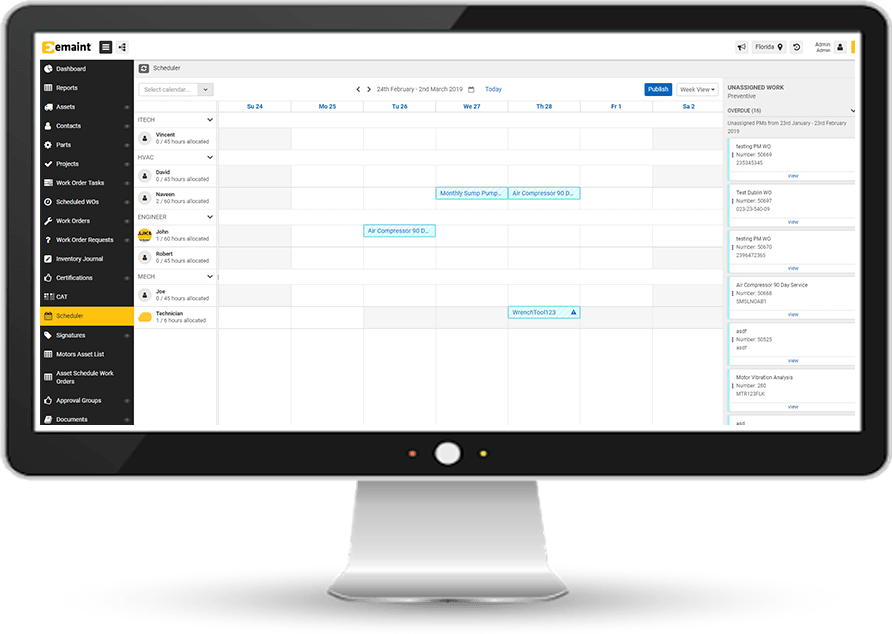
O que é a manutenção programada?
Scheduled maintenance is any planned repair or service task performed within a specified timeframe. This includes routine inspections, adjustments, and regular service, as well as planned shutdowns. Scheduled maintenance can be recurring, performed at regular intervals, or triggered by a specific work request. It is designed to proactively address potential issues, ensuring efficient and timely upkeep of equipment and systems.
Completing tasks is only part of scheduled maintenance. Who finishes the task, where it takes place, and how long it takes are all crucial parts of the maintenance schedule. Even if you know which assets require repairs, you still need to pick the ideal person for the job and the optimal time to do it. Without proper organization, keeping track of everything can be a headache. That is why optimized scheduled maintenance requires a CMMS, or computerized maintenance management system, to help manage work orders, assets, maintenance tasks, and more.
Qual é a diferença entre manutenção planeada e manutenção programada?
The terms planned maintenance and scheduled maintenance are often used interchangeably, but they are separate examples of preventive maintenance. A comprehensive asset maintenance strategy requires planned and scheduled maintenance working in tandem.
A manutenção planeada é o processo de previsão ou antecipação das necessidades de manutenção de activos e de planeamento estratégico da manutenção futura. A manutenção planeada é um termo abrangente que engloba a manutenção preventiva, a manutenção preditiva e as estratégias de manutenção baseadas nas condições.
Scheduled maintenance is the process of determining who should complete maintenance tasks and when they should be completed. Rather than forecasting future maintenance needs, scheduled maintenance focuses on resolving issues that have already been identified, assigning a worker to the task, and setting a deadline for task completion.
What Are the 4 Types of Maintenance?
Scheduled maintenance is a crucial component of effective asset management, ensuring equipment reliability and operational efficiency. There are several core types of scheduled maintenance, each serving a unique purpose in maintaining equipment health and changing the way tasks are scheduled.
Understanding these types of maintenance helps organizations implement a tailored maintenance strategy that optimizes equipment performance and reduces cost. It allows them to schedule maintenance that meets the precise needs of the operation, all without wasting time scheduling unnecessary tasks or last-minute repairs after downtime has derailed operations.
Here are the four types of maintenance:
Manutenção baseada no tempo
Maintenance activities are scheduled at regular, predefined intervals (e.g., weekly, monthly, quarterly). An example of this would be regular oil changes in machinery every three months to ensure optimal performance. Time-based maintenance removes guess work from maintenance scheduling. Completion dates for tasks are set; then, a schedule can be built around them. This type of maintenance prevents unexpected breakdowns and prolongs equipment lifespan.
Manutenção baseada na utilização
With this maintenance type, tasks are triggered based on usage metrics (e.g., operating hours, production cycles). For example, replacing HVAC system filters after 1,000 hours of operation. Usage-based maintenance requires a bit more data than time-based maintenance, as the usage of each individual asset must be closely monitored. This makes scheduling more efficient by aligning maintenance activities with actual equipment usage, reducing unnecessary maintenance.
Manutenção Preditiva (PdM)
Predictive maintenance uses real-time data and advanced analytics to predict when maintenance should be performed. An example of this would be performing vibration analysis on rotating equipment to detect early signs of wear and schedule maintenance before failure occurs. More recently, AI has been integrated to further enhance insight quality. Scheduling with a predictive model minimizes downtime and maximizes asset availability by addressing issues before they escalate.
Manutenção baseada na condição (CBM)
Maintenance is performed based on the actual condition of the equipment, often monitored with sensors and diagnostic tools. An example of this would be only performing maintenance on a generator when data indicates it’s operating outside of normal parameters. This allows scheduling to focus resources on equipment that truly needs attention and reduces time spent working on machines that have no irregularities.

Industries That Rely on Scheduled Maintenance
Transportes
Scheduled maintenance keeps workers on the road and cars out of the garage. When vehicles get regularly scheduled oil changes and tune ups, they are less likely to break down. In turn, transportation companies can complete more work orders, improve vehicle reliability, and slash emergency maintenance costs.
Fabricação
The majority of manufacturing plants schedule maintenance ahead of time. Scheduled maintenance helps keep assets in good working order, which reduces interruptions to operations and keeps production consistent.
Saúde
In addition to essential medical devices, healthcare facilities have numerous assets like lighting, HVAC systems, and water heaters to maintain. Proactive scheduled maintenance is necessary to keep these crucial systems in optimal condition.
O que é a manutenção programada de fábrica?
A manutenção programada na fábrica - uma forma de manutenção baseada no tempo - é um bom exemplo de manutenção programada recorrente. Envolve a verificação de potenciais problemas enquanto se efectua a manutenção de rotina em intervalos definidos. A maioria dos veículos de consumo necessita de manutenção em intervalos de quilometragem definidos para se manterem a funcionar de acordo com as especificações do fabricante e manterem as garantias activas. Do mesmo modo, cada peça de equipamento vem com um calendário de manutenção recomendado pelo fabricante.
While forgoing factory scheduled maintenance may seem like an opportunity to reduce expenses, routine maintenance inspections can be essential to finding and resolving problems early. As a result, keeping assets up to date with factory-recommended maintenance may reduce costs in the long run. (Of course, condition-based maintenance may be an even better approach if properly implemented.)
Quais são os benefícios da manutenção programada?
A manutenção programada garante um desempenho fiável dos activos e reduz o tempo de inatividade não planeado, mantendo o equipamento em boas condições de funcionamento. Também o ajuda a identificar problemas antes de estes se transformarem em avarias ou paragens. Uma manutenção programada adequada prolonga a vida útil dos activos e mantém as suas garantias activas. Todas estas tarefas podem ser facilmente executadas utilizando um software de programação de manutenção robusto.
A implementação de um programa de manutenção programada oferece inúmeras vantagens que aumentam a eficiência e a longevidade do equipamento e dos sistemas. Eis os principais benefícios:
Melhoria da fiabilidade do equipamento
Regular maintenance ensures that equipment operates at peak performance, reducing the likelihood of unexpected breakdowns. Routine inspection and servicing of machinery prevents sudden failures that could disrupt production.
Prolongamento da vida útil dos activos
Ao tratar do desgaste atempadamente, a manutenção programada prolonga a vida útil do equipamento e reduz a necessidade de substituições prematuras. A lubrificação regular e a substituição de peças mantêm as máquinas a funcionar sem problemas, prolongando a sua vida útil.
Less Unplanned Downtime
A manutenção programada minimiza o tempo de inatividade inesperado, resolvendo proactivamente os potenciais problemas antes que estes conduzam a falhas. Uma fábrica que segue um calendário de manutenção rigoroso tem menos paragens de produção devido a avarias do equipamento.
Poupança de custos
A manutenção preventiva de rotina pode poupar dinheiro, evitando reparações de emergência dispendiosas e reduzindo a frequência de grandes revisões. A realização de manutenção programada em sistemas AVAC evita avarias dispendiosas e prolonga o tempo entre grandes remodelações.
Segurança reforçada
A manutenção regular garante que o equipamento funciona em segurança, reduzindo o risco de acidentes e lesões. As verificações regulares dos sistemas de segurança das máquinas industriais garantem que todas as medidas de proteção estão a funcionar, evitando acidentes de trabalho.
Conformidade com os regulamentos
Scheduled maintenance helps organizations comply with industry regulations and standards, avoiding penalties and ensuring safe operations. This is especially important for strictly regulated medical device manufacturing assets. Adhering to maintenance schedules ensures proper compliance.
Melhoria da eficiência
O equipamento com uma boa manutenção funciona de forma mais eficiente, reduzindo o consumo de energia e melhorando a produtividade global. A manutenção regular das máquinas da linha de produção garante o seu funcionamento eficiente, reduzindo os custos de energia e aumentando a produção.
Melhor gestão dos recursos
A manutenção programada permite um melhor planeamento e atribuição de recursos de manutenção, optimizando a mão de obra e o inventário de peças. A utilização do software CMMS para planear as tarefas de manutenção garante que os técnicos e as peças estão disponíveis quando necessário, reduzindo o tempo de inatividade.
Deteção precoce de problemas
As inspecções e a manutenção de rotina ajudam a identificar precocemente potenciais problemas, antes que estes se transformem em problemas graves. As verificações regulares do equipamento das instalações podem identificar fugas ou pontos fracos antes que estes causem danos significativos.

O que é um exemplo de programação de manutenção?
Scheduled maintenance can be seen throughout any typical manufacturing facility or factory floor. Take a conveyor belt as a potential example. The belt and bearings slowly wear out over time, and routine maintenance is necessary to prevent any negative effect on performance.
The required service can be as simple as checking belt alignment or as complex as completely replacing bearings at set intervals. Regardless of the maintenance task, it always needs to be scheduled. When building the schedule, the maintenance planner must take several factors into account — the task priority level, technician availability, and existing scheduled maintenance.
If the schedule is designed around time-based maintenance and the required task is routine, this process will be more rigid. There is already a predetermined time when maintenance needs to be completed. The exact time just depends on a technician’s availability. If there is a bigger problem with the belt, or monitoring indicates a check is needed, then the speed at which the task can be completed will depend on existing scheduled tasks. Once that’s determined, a work order will be created, and the maintenance will officially be scheduled.
Duplique este processo dezenas ou centenas de vezes, dependendo da dimensão da organização, e terá uma boa ideia da complexidade da manutenção programada.
O que é o SMCP?
A percentagem crítica de manutenção programada (SMCP) é uma métrica utilizada para dar prioridade às tarefas de manutenção, especialmente quando existem várias tarefas em atraso. A SMCP calcula o número de dias que uma tarefa de manutenção está atrasada em relação à frequência com que a tarefa de manutenção está programada para ocorrer. O número resultante é expresso como uma percentagem. Quanto mais elevada for a percentagem, mais elevada deve ser a tarefa na lista de prioridades de manutenção para uma eficiência máxima.
Como calcular o SMCP
The formula for SMCP is fairly simple. Start by adding the number of days late a task (or PM) is to the number of days in a maintenance cycle. Then, divide the sum by the number of days in the maintenance cycle and multiply that result by 100.
(# de dias de atraso + # de dias no ciclo PM) ÷ # de dias no ciclo PM x 100 = SMCP
This provides you with a percentage that expresses exactly how to prioritize a list of overdue tasks. It can then be used to more efficiently allocate resources, saving you time and money.
Scheduled Maintenance Critical Percent (SMCP) Example
Como é que é o SMCP em acção? Vamos considerar um sistema em que várias tarefas de manutenção estão actualmente atrasadas. A tarefa 1 é normalmente concluída a cada 45 dias e está agora 4 dias atrasada. Entretanto, outra tarefa é concluída a cada 30 dias e está agora com 3 dias de atraso. A Tarefa 3 está num ciclo de 90 dias e está 7 dias atrasada.
Que tarefa deve a sua equipa de manutenção concluir primeiro? À primeira vista, pode parecer lógico abordar primeiro a tarefa mais atrasada, mas essa pode nem sempre ser a melhor opção.
Vamos aplicar um cálculo rápido do SMCP para o descobrir:
Tarefa #1: (4+45) ÷ 45 x 100 = 109%
Tarefa #2: (3+30) ÷ 30 x 100 = 110%
Tarefa #3: (7+90) ÷ 30 x 100 = 108%
Based on SMCP, Task 2 has the highest percentage and should be prioritized ahead of Tasks 1 and 3, even though those tasks are more days overdue. Since Task 2 has the shortest maintenance cycle, three days of overdue maintenance has a larger impact on the machine than the longer day counts seen with the other tasks.
Benefits of Tracking SMCP
There are four key benefits to tracking SMCP:
- Improve efficiency: Your scheduled maintenance critical percentage helps you prioritize tasks based on how far you’ve departed from your regular schedule.
- Reduce reactive maintenance: With an effective system to catch up on backlogged tasks, you can spot more potential failures before they become urgent. This leads to more uptime and improved safety.
- Reduce costly downtime: SMCP helps prioritize your most overdue maintenance tasks, which lowers the risk of equipment failure. That cuts unexpected downtime, which reduces costs thanks to increased productivity, decreased emergency maintenance, and prolonged asset life.
- Simplify audits: Reducing your backlog helps you remedy potential compliance issues before audits occur.
Tracking SMCP simplifies scheduling while reducing costs associated with reactive maintenance practices, unexpected downtime, and compliance violations.
Como criar um calendário de manutenção
Ao integrar a manutenção programada na sua estratégia de manutenção, pode garantir que os seus activos permanecem fiáveis, eficientes e seguros. No entanto, tem de se certificar de que cria o seu calendário corretamente para colher os benefícios. Eis os passos a seguir para criar um calendário de manutenção:
Determinar as suas necessidades de activos e criar um plano
Before scheduling can begin, you need to know your exact requirements. Take stock of all assets in the facility, their required maintenance cadences, and build out a rough plan of how to handle them. You should also know how many maintenance technicians are on site and what their availability looks like. All the prep work that goes into this stage of the process will make all other steps much easier.
Implementar uma plataforma
Gone are the days of paper work orders and manual documentation. A modern maintenance schedule requires some level of digital integration with a scheduling tool. Leveraging a CMMS can streamline your scheduled maintenance processes, making it easier to reap the advantages. Make sure to get a scheduling platform that fits the size of your operation and has all the functions you will need to maintain your assets.
Dar prioridade às tarefas
Em seguida, é altura de dar prioridade aos bens de missão crítica e construir um esqueleto do seu calendário. Isto garante que a manutenção se concentra nas áreas mais importantes e é extremamente útil se os recursos forem limitados.
Agendar tarefas e definir acompanhamentos
Once assets have been identified and ranked, it is time to start scheduling. Schedule out maintenance tasks in order of importance and as efficiently as possible. It’s impossible to have a perfect schedule, but you should strive to avoid disruptions and minimize downtime. Once an initial round of maintenance has been completed, build in automatic triggers to reschedule routine maintenance at the appropriate cadence.
Ajustar e otimizar
Even after a schedule is made, it is never set in stone. Even with your best efforts, failures will still happen, and high-priority maintenance will have to be scheduled. Create your schedule with this in mind, leaving some flexibility for on-the-fly adjustments. Once maintenance tasks are in full swing, take note of what’s working and what might be causing bottlenecks. Always observe and optimize the schedule as needed.
How to Write Scheduled Maintenance Messages
All parties throughout your organization must have access to relevant information for scheduled maintenance tasks. The best way to do that? Clear and concise maintenance messages. Follow these best practices for effective work orders and communications:
- Provide ample notice for all requested work. With the exception of corrective and emergency maintenance, you should schedule all maintenance efforts well in advance by several days, if not weeks or months. This allows ample time to order necessary inventory and plan for downtime.
- Consider widespread impact. Beyond the maintenance professionals performing the work, who else will feel the impact of these scheduled maintenance activities? Consider affected staff and processes across production, warehouse, office, and beyond — then tailor your communications to each group.
- Include all relevant details. If your work order requires follow-up questions, it’s not comprehensive enough. Include assigned resources, dates and time estimates, description of the work, location, and necessary tools and parts.
- Communicate effectively. Use standardized operating procedures (SOPs) to establish the right communication channels for each type of maintenance. In addition to updating your computerized maintenance management system (CMMS), you may also wish to send emails, hold meetings, or publish updates on an intranet system.
A successful scheduled maintenance program includes consideration for all parties and facilities. Timely, detailed communication is the best way forward.
Implementar um CMMS para impulsionar a sua manutenção programada
A comprehensive maintenance strategy ensures asset reliability and performance and keeps your operations running smoothly. Using a CMMS like eMaint to incorporate scheduled maintenance into your maintenance strategy — along with other proactive measures like real-time condition monitoring and predictive maintenance— will help prevent shutdowns and unexpected maintenance costs.
FAQS sobre manutenção programada
O que é a manutenção programada?
A manutenção programada é a atribuição de tarefas de manutenção a um técnico dentro de um período de tempo específico. Pode ser uma verificação de rotina com uma cadência definida ou um serviço de última hora necessário para evitar a paragem da máquina.
Porque é que a manutenção programada é importante?
A manutenção programada é importante porque garante que as máquinas são devidamente tratadas, melhorando a eficiência operacional e a vida útil dos activos. Alguns dos benefícios da manutenção programada são a melhoria da fiabilidade do equipamento, a redução do tempo de inatividade não planeado, o aumento da segurança, a redução dos custos de manutenção e uma melhor gestão dos recursos.
What Does a Maintenance Scheduler Do?
A maintenance scheduler reviews maintenance requirements, capacity, resources, and inventory to schedule maintenance tasks and manage resource allocation accordingly.
Depending on the size of your company’s operations, a maintenance scheduler may be a person (such as a maintenance manager) or a software system. As you scale, the automation and data analysis features afforded by enterprise asset management (EAM) tools and computerized maintenance management systems will become critical to your maintenance scheduling process.
Com que frequência deve ser programada a manutenção?
A manutenção deve ser programada com base nas instruções do fabricante, na disponibilidade do técnico e nas normas da organização. A cadência exacta da manutenção dependerá da máquina a ser assistida, dos seus padrões de utilização e do ambiente em que se encontra. Em última análise, a manutenção pode mesmo ter de ser programada de forma reactiva devido a uma avaria do equipamento.
How Can I Implement an Effective Scheduled Maintenance Program?
To implement an effective scheduled maintenance program, follow these steps:
- Take inventory of all assets
- Determine requirements for each asset using manufacturer guidelines and your data
- Implement a CMMS
- Train staff
- Prioritize tasks
- Document standard operating procedures
- Issue work orders
- Perform scheduled maintenance, including regular inspections
- Track completed tasks
- Measure impact using comprehensive reporting tools from your CMMS
- Adopt a continuous improvement approach
This process starts with data-driven decision-making and aims to establish standardized processes. But it’s not rigid — built-in adaptability helps you consider new information and improve along the way.