
Predictive maintenance spending is on track to grow sevenfold by 2033, from roughly $14 billion to nearly $98 billion, fueled by AI, IoT sensors, and machine analytics. Most of the conversation around that growth focuses on what AI can detect: abnormal vibration, early bearing wear, subtle thermal drift. Those capabilities are real, and the results are already showing up on balance sheets; one manufacturer avoided more than $8 million in downtime costs within six months.
But detection is one part of the story. The other, more consequential question is what a company does with the insight once it has it. Leading organizations aren’t just asking what AI can predict; they’re asking how to deploy it across the enterprise to drive better decisions and faster execution. That’s where leadership matters more than technology, and where most operations are leaving value on the table. That shift plays out in three places.
1 – Extending the value of predictive insight
Identifying abnormal machine behavior before a failure occurs gives maintenance teams an advantage, but acting on that insight still takes time, and time is where value is lost. The technician assigned to the asset needs to piece together context about the asset under pressure, and faces a scavenger hunt across multiple sources such as CMMS/EAM records, tribal knowledge, scattered documentation, etc.
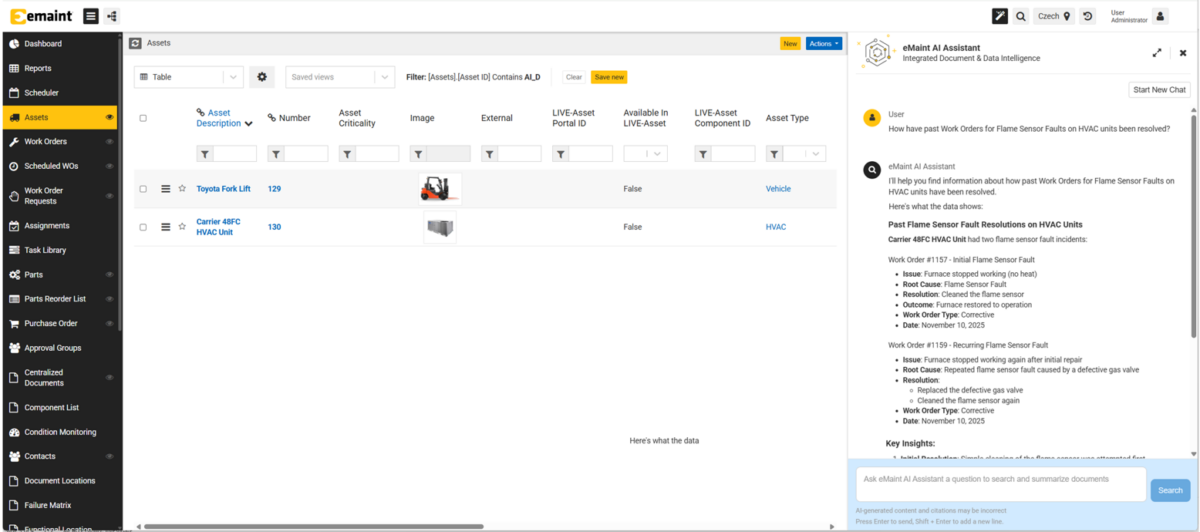
Modern AI-enabled platforms collapse this execution gap. An AI‑enabled maintenance management platform can auto-assemble the response package: specific work order history, relevant SOP sections, annotated schematics, prior technician notes. The technician moves from alert to informed action in minutes, not hours.
That is where predictive insight translates into operational impact.
2 – Turning expertise into infrastructure
The loss of experienced technicians is already reshaping maintenance economics. According to a Fluke survey of manufacturing professionals, 97% view AI as a viable solution to the skills shortage. But most are deploying it solely as a search tool rather than also considering the use of AI as an expertise engine. The strategic opportunity is knowledge multiplication, not just knowledge access.
Consider how this could change a technician’s day.
- Instead of having to walk back to a laptop, they simply use voice-to-text on a mobile device to log an issue.
- As the work order is created, AI cross-references the description against technical documentation and years of historical data and notes already in the CMMS or EAM system.
- The AI assistant writes the next steps directly into the work order: “This symptom usually indicates bearing wear. Inspect parts 3, 5, and 8. Follow the SOP used in the previous repair. Relevant technician notes are included below.”
This is institutional knowledge put into action. The technician isn’t relying on personal experience or hunting for a senior colleague. They’re operating with the accumulated wisdom of the organization, codified and delivered at the point of need. This pivot fundamentally upgrades the organization’s operating rhythm:
- Consistency at scale: The “tribal knowledge” that once lived in silos becomes a standardized component of daily execution. When every technician, shift, and site operates from a unified “source of truth,” performance variability narrows.
- Accelerated training: Junior staff acquire effective experience much faster.
- Better use of experts: Senior technicians shift from routine execution to complex problem-solving and system optimization.
Expertise that lives in workflows survives turnover. Expertise that lives in people leaves with them.
3 – Raising the baseline of maintenance decision-making
Most maintenance operations have a data abundance problem masquerading as a data shortage. Metrics are everywhere; usable intelligence is scarce. Decisions stall because pulling the right view takes a planner half a day or requires an analyst who’s already booked. That dependency creates delays, and that’s a constraint leaders can solve with AI.
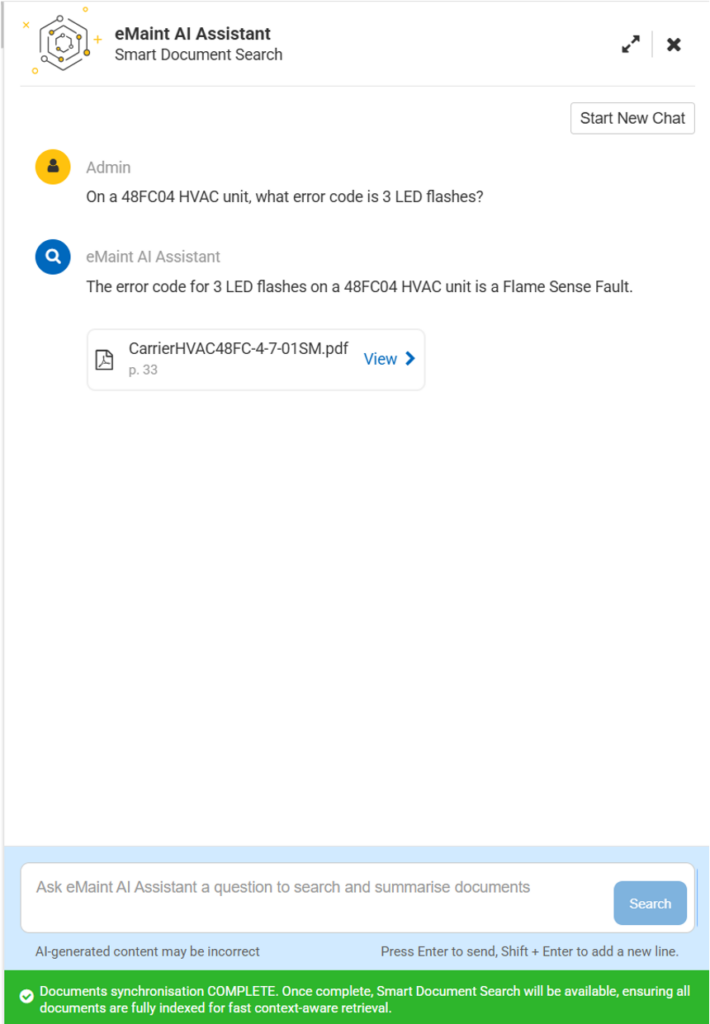
AI shifts the paradigm from static reporting to interactive intelligence.
For example, instead of filing a request or waiting on an analyst, a supervisor can ask a direct question — show me related issues on this asset over the past 90 days — and see the trend in seconds. Systemic issues surface before they become chronic. Course corrections happen on evidence, not instinct.
The compounding effect matters more than any single query. As work orders follow more consistent patterns, data quality improves. As data quality improves, AI insights get sharper. For leadership, this transforms maintenance from a cost center struggling with variance into a high-precision operation characterized by measurable, compounding gains.
The real question for leadership teams
Here’s what leadership teams need to recognize: AI’s value in maintenance is not only technical – it’s organizational. This requires thinking differently about how AI is used across three levels:
- Individual: Faster, more informed responses to problems
- Team: Shared knowledge and more consistent execution across sites
- Organization: Faster learning and better decision-making at scale
Leaders who architect for all three will create compounding advantages that competitors cannot easily replicate. Some organizations will use AI to reduce costs. Others will use it to build a more responsive, more consistent, and more resilient maintenance operation.