
Part 2: What We Heard — Key Takeaways from the Women in Reliability Panel
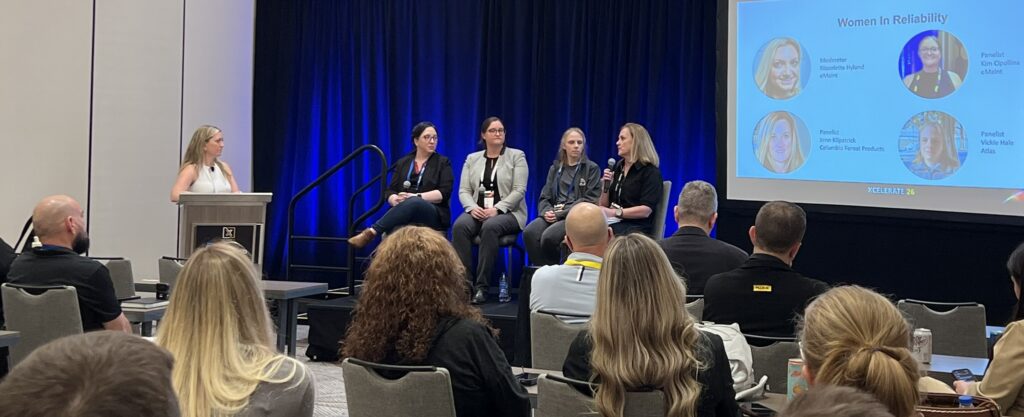
Xcelerate 2026 brought together maintenance and reliability professionals from across industries for three days of learning, connection, and honest conversation. And in what became one of the most memorable sessions of the conference, eMaint hosted its first-ever Women in Reliability panel.
The room was full. The conversation was real. And what came out of it mattered — not just for the women in the room, but for anyone who leads a team, works on a floor, or cares about building stronger reliability programs.
Here is what we heard.
Differences Are Not Obstacles — They Are Operational Assets
One of the clearest themes that emerged from the panel was this: the differences people bring to a team are not things to manage around. They are things to build with.
In reliability and maintenance environments, teams are often made up of people with very different backgrounds — different technical training, different industry experience, different ways of processing and communicating information. The instinct is sometimes to smooth those differences over, to find a common language and move quickly. But the panelists pushed back on that.
When you take the time to understand how someone else sees a problem, you often find they are seeing something you are not. That is not a distraction from reliability work. That is reliability work.
“The person who sees it differently isn’t wrong — they’re seeing something you’re not.”
Panelist: Jenn Kilpatrick, Columbia Forest Products
The connection to reliability outcomes here is direct. Failures rarely announce themselves. They show up as small signals at first, maybe a sound that seems slightly off, a pattern in the data that does not quite fit, or even a workaround that has quietly become standard practice. The problem is though that these are the early indicators of failure modes that never make it into a formal RCA. The teams that catch those signals earliest are the ones where people feel like their observations are worth sharing. And you see it in the numbers: lower MTTR, fewer unplanned failures, better asset uptime.
Holding Space: What It Actually Looks Like at Work
The panel did not spend time on abstract ideas about inclusion. The conversation stayed grounded in practice and specifically, what it looks and feels like to hold space for everyone on a team in a real operational environment.
Holding space does not mean slowing everything down or running every decision by committee. It means building the kind of culture where people closest to the work feel confident enough to speak up about a failure they are seeing develop, about a process that is not working, or about an idea they have been sitting on.
The difference between a team that runs reactive maintenance and one that runs a mature predictive program often comes down to exactly this — whether people feel safe flagging what they notice before it has to become a work order.
“You don’t need a seat at every table. You need people at the table who know how to listen.”
Panelist: Nikki Smith, Lineage Logistics
For leaders in the room, this landed as a practical challenge: how do you create the conditions where your quieter team members are as likely to flag a problem as your loudest ones? Because in reliability, the person who notices something first is not always the one most comfortable saying so.
What This Means for Your Team
The behaviors discussed in this panel are not exclusive to any one group. They are high-performance reliability practices that any team can adopt.
If you are a leader, ask yourself: when was the last time someone on your team told you about a problem before it showed up in your CMMS data or triggered an unplanned work order? If the answer is rarely, it may be worth looking at whether the conditions exist for that conversation to happen.
If you are a practitioner, the panel was a reminder that your perspective, the one built from years of floor experience, from pattern recognition that does not always fit neatly into a report, is exactly what reliability programs need more of.
The Conversation Continues
This panel was a beginning, not a summary. The energy in the room made it clear that there is more to say and more people who want to be part of saying it.
If you missed the session at Xcelerate, keep an eye out: the team also sat down with Industrial Talk Media for a podcast episode that goes even deeper into these themes. That episode will be dropping in the coming weeks — we will share it when goes live.
In the meantime, we would love to hear from you. What resonated? What would you add to this conversation? Connect with us and let us know.
Missed Part 1? Read Why Women in Reliability Matters Now More Than Ever to meet the panelists and learn what brought this session to Xcelerate for the first time.