

Successful parts inventory management involves a lot of careful balance, especially when it comes to critical spares. On one hand, keeping too many component parts around can be expensive, both in terms of money and space. Most operations can’t afford to keep a backup of every part they’ll ever need in the warehouse.
Por otro lado, si no tiene piezas críticas en stock, es mucho más probable que sufra tiempos de inactividad imprevistos o riesgos para la seguridad. No puede permitirse detener la producción cada vez que una pieza clave se desgasta, sobre todo teniendo en cuenta la realidad de los problemas actuales de la cadena de suministro.
Entonces, ¿cómo puede decidir qué componentes de activos mantener en stock? En este artículo, le mostraremos cómo evaluar la criticidad de las piezas de repuesto. También hablaremos de cómo la criticidad se vincula a una estrategia de mantenimiento más proactiva.

¿Qué son los repuestos críticos?
Critical spares are the components that your operation must have in order to stay up and running. Without these parts, your production line will break down, and you won’t be able to meet deadlines or deliver products.
Most of the time, critical spare parts refer to the components that are necessary for your key production equipment. However, in many cases, your maintenance tools for these parts are also critical. Critical spare parts management includes responsible management of maintenance tools and parts, as well as any important components that are custom-made or that take a long time to ship.
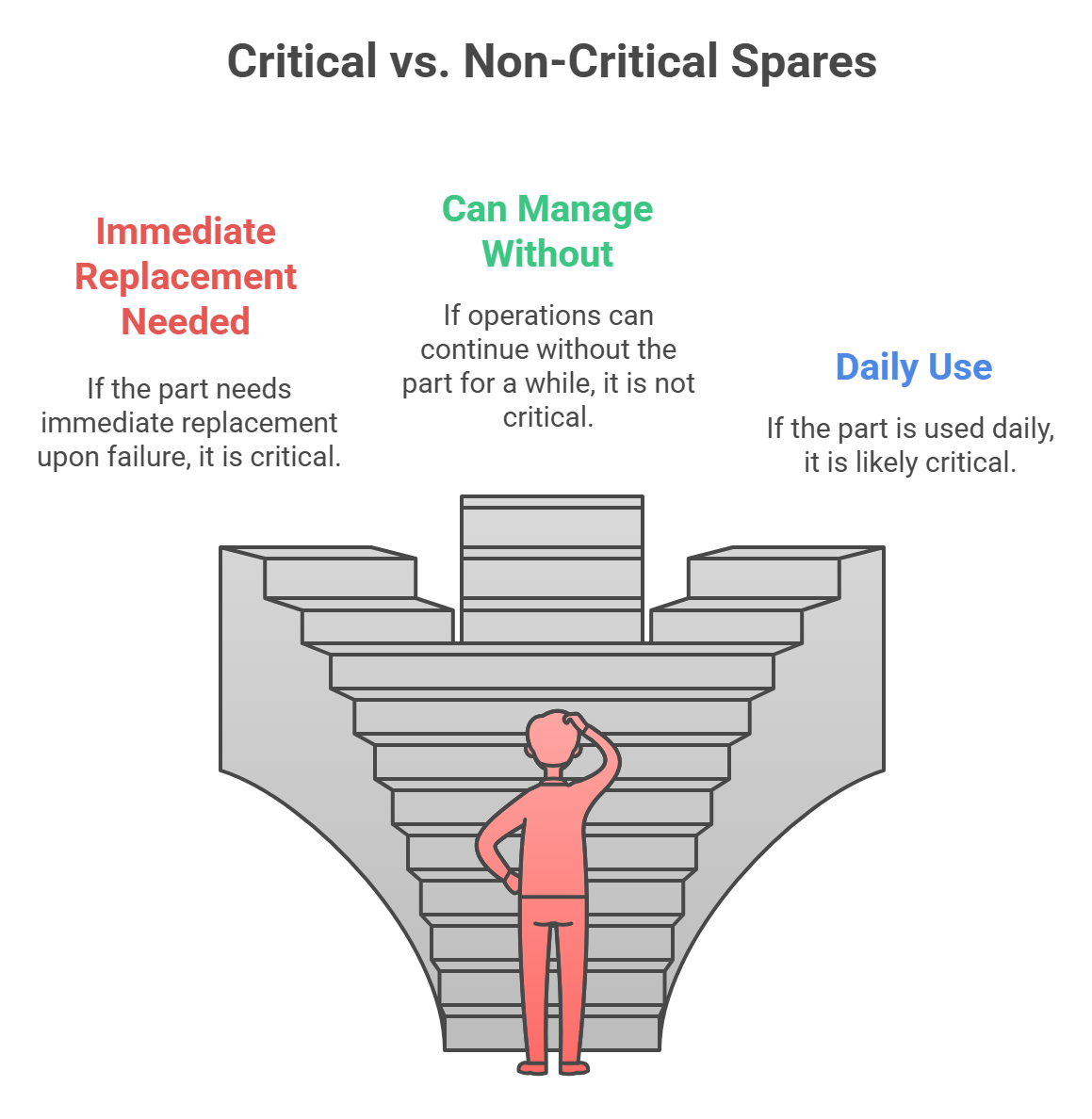
Not sure whether a particular part is critical? Ask yourself: If that part fails, how quickly will you need to replace it? If the answer is right away, then it’s a critical part.
Por otro lado, si puedes arreglártelas bien sin él durante un tiempo, entonces no es crítico.
También puede pensar en la frecuencia con la que utiliza un activo concreto. Si depende de alguno de sus equipos todos los días, probablemente sea crítico, aunque no forme parte de su línea de producción.
Talk to your teams and get their views on which equipment is most important. That’s the first step to carrying out an Asset CriticalityAssessment (ACA).
Evaluación de la criticidad de las piezas de repuesto
Typically, team members will all have different ideas of which parts are most critical. If you haven’t already done an ACA, also called a spare part assessment, you should run one as soon as possible. Talk to everyone involved and get detailed reporting on the assets that they identify as critical. Computerized Maintenance Management System (CMMS) software is also a valuable tool in assessing asset criticality.
Una vez que haya determinado qué activos son los más importantes para su empresa, es cuestión de asegurarse de que tiene en stock las piezas esenciales para esos activos.

The Benefits of Effective Criticality Assessments and Critical Spares Management
These are the key factors that show why critical spare parts management matters for your core operations.
Avoid Costly Downtime
Keeping critical spares on hand means you’ll see a drastic reduction in unplanned downtime. You won’t be caught off guard when a motor suddenly stops running or when a fan breaks down, because you’ll have a backup part in your storeroom. As a result, you’ll keep your plant running longer and avoid excess costs from unplanned downtime.
Reduce Costs for Parts and Shipping
You’ll also likely pay lower shipping costs and may even pay less for each spare part. Planning ahead means you’ll avoid expensive rush shipping and be able to look around for the best prices available.
Improve Inventory Levels
Of course, figuring out which spares are critical can also help you make better use of your storage space. Once you determine which parts are critical, you can eliminate many of the non-essential parts from your warehouses. That means that your storage spaces will be leaner, better organized, and easier to navigate.
Enhance Operational Efficiency
With the right parts in stock, you’ll also reduce lead times to enable more efficient maintenance planning and execution. Effective parts inventory management also helps strengthen relationships with your suppliers, which, in turn, can improve your critical spare management. As a loyal customer, you’ll likely be the first to know when supply chain disruptions occur.
Plus, predictive maintenance technologies can help identify potential failures that, if left unchecked, could lead to costly downtime, production delays, and extensive repairs. This alerts your team to restock those repair parts.
¿Qué es la diferencia entre piezas críticas y estratégicas?
Teams must keep critical spares on hand to prevent immediate downtime or safety risks. But many organizations also stock strategic spare parts to reduce risks such as long lead times, obsolescence, or sourcing challenges. Both strategic and critical spares are important, but they serve different purposes.
Unlike critical spare parts, strategic spare parts address issues that might not stop operations immediately but could compromise long-term asset functionality or lifespan. The goal of keeping strategic parts on-hand is to maximize an organization’s ability to maintain and support its assets over time, so technicians can continue to maintain assets without replacing them.
Entre las razones más comunes para mantener piezas de repuesto estratégicas en un inventario se incluyen:
- Obsolescencia: A medida que los equipos envejecen, las piezas de repuesto pueden ser más difíciles de encontrar. Mantener un inventario estratégico de repuestos ayuda a tener siempre a mano las piezas adecuadas.
- Long lead times: If a part takes an unusually long time to procure, keeping a small inventory of parts can help minimize downtime.
- Problemas de abastecimiento: Las interrupciones de la cadena de suministro mundial o los problemas de fiabilidad de los proveedores pueden dificultar la obtención de determinadas piezas. Mantener un stock estratégico ayuda a reducir el riesgo de que los activos se vuelvan irreparables debido a componentes no disponibles.
Whether you’re managing critical or strategic spare parts, following best practices enables you to support operational continuity and reliability with your spare parts management strategy.
What Is the Difference Between Insurance Spares and Critical Spares?
Insurance spares are a subset of strategic parts. These are parts that a facility doesn’t expect to equip for an asset’s normal functions; they’re very rarely needed. However, if these parts aren’t available during a critical equipment failure, it would lead to excessive, costly downtime with major revenue loss.
These spares are often expensive and come with long lead times. So, if you wait to order them until an equipment failure occurs, it compounds the impact to budget and time.
These parts are called insurance spares because having them on hand is a form of insurance against significant potential loss.
What Are Four Types of Spare Parts?
Apart from classifying specific parts as critical versus non-critical, there are other types of parts you can order.
Original Equipment Manufacturer (OEM) parts are those produced by the manufacturer of your asset. They may be among the most expensive, as they’re typically high-quality and very reliable. However, since the original manufacturer designs and produces them, they’re also the most likely to match your asset perfectly. Most notably, OEM parts won’t void your equipment warranty.
Aftermarket parts come from a third-party manufacturer. They’re less expensive compared to OEM parts, but many good-quality aftermarket parts feature premium engineering to match OEM specifications. It’s important to research the quality and durability of these parts. Also, some aftermarket parts may void your asset warranty.
Remanufactured parts are non-new parts that have been refurbished to function like new. They’re cheaper than OEM parts but have a more limited lifespan. Remanufactured parts may not be available for all equipment types, and not all parts are available as remanufactured parts.
Finally, used parts are non-new parts that have operated in equipment previously but have not been refurbished. This makes them very inexpensive. However, due to their wear and lack of refurbishment, the functionality and useful lifespan of these parts is unreliable. Employ used parts sparingly and cautiously — never for high-risk or safety components.
How To Adopt a Critical Spare Parts Inventory Strategy
Once you’re ready to implement this inventory management approach, here are some of the first steps you should take:
- Conduct your asset criticality assessment. Start by classifying parts as critical or non-critical.
- Modify your maintenance strategies. Forward-thinking strategies such as predictive maintenance, preventive maintenance, and Condition-Based Maintenance (CBM) improve accuracy in maintenance planning and inventory levels.
- Revise your orders for lower-demand spares. Check ordering frequency and inventory levels for non-critical items at your organization and adjust accordingly, so you can free up space for critical items.
- Adjust budget allocation for critical spares. Auditing procurement for non-critical spares should allow you to reallocate new funds for essential parts.
- Order sufficient critical spares. Now that you know which parts are critical, it’s time to put in the appropriate orders to get your inventory levels to where they need to be.
- Monitor asset performance with essential metrics. Use calculations such as Mean Time Between Failures (MTBF) and Mean Time to Repair (MTTR) to make data-driven decisions.
Learn more about the seven most important maintenance metrics.
This balance of assessments, strategies, inventory management, and asset performance monitoring ensures an efficient and effective approach to implementation.
Buenas prácticas para la gestión de repuestos críticos
La adopción de algunas prácticas clave puede transformar su sistema de gestión de piezas de recambio críticas. He aquí algunas de las mejores estrategias.
Establecer prioridades eficaces
Assess how often your critical spare parts need to be replaced. Start by carrying out an asset criticality analysis or conduct a new one if it’s been a while since the last ACA. Studying your work order history will also give you more insights into each asset’s maintenance needs.
A la hora de pedir y almacenar piezas, dé prioridad a los repuestos críticos que necesiten sustituirse con frecuencia. Asimismo, procure obtener piezas con plazos de entrega largos para que no le pillen desprevenido los retrasos inesperados en los envíos.
Utilice un sistema eficaz de seguimiento de repuestos críticos
Use a cloud-based tool to track the location of your critical spares, especially if your team has multiple warehouses or facilities. Look for a tool that can also track when parts were last ordered and when they need to be reordered. It’s a good idea to use QR codes or RFID tags that you can scan to automatically update inventory.
Standardize inventory processes so that all of your inventory is tagged and scanned upon arrival in the warehouse. This will require some additional training and supervision at the outset, but it will pay off quickly. Systematic tagging and scanning mean you’ll be able to easily locate every piece of inventory in your organization across all of your facilities.
Adoptar una estrategia de mantenimiento proactiva
El mantenimiento proactivo le saca del modo reactivo, ofreciéndole información basada en datos para mejorar el mantenimiento y la planificación del inventario.
Approaches like preventive maintenance and predictive maintenance extend the lifespan of your assets and reduce unexpected downtime at your facilities. As a result, you won’t face sudden, unexpected breakdowns that leave you scrambling for spare parts.
Discover how the right EAM solution can cut downtime and help you stay proactive.
Repuestos críticos y mantenimiento proactivo
Una estrategia de mantenimiento proactivo puede ayudarle a tener siempre en stock los repuestos críticos que necesita. El mantenimiento proactivo significa ir unos pasos por delante de los fallos de los equipos controlando el estado de sus activos. Si supervisa sus activos en busca de señales tempranas de defectos, siempre sabrá con antelación cuándo hay que sustituir o reparar una pieza.
This can be as simple as having your crews carry out route-based vibration monitoring on a regular basis. Changes in vibration patterns sometimes indicate new machine faults. The sooner you discover those faults, the sooner you can order the parts you need to fix them.
También puedes construir un sistema de monitorización de vibraciones utilizando monitores de vibraciones inalámbricos y un GMAO. Los monitores de vibraciones recopilan datos de vibraciones de forma continua para que nunca se pierda ninguna información clave. Y puede configurar su GMAO para que cree automáticamente una orden de trabajo siempre que los niveles de vibración superen sus parámetros.
How To Prepare for Critical Spare Parts Shortages
Los atascos en la cadena de suministro son una realidad, y no parece que eso vaya a cambiar. Afortunadamente, una planificación cuidadosa puede ayudar a amortiguar el impacto de la escasez y las subidas de precios. He aquí cómo proteger su cuenta de resultados.
Mejore su capacidad de previsión
Stock up ahead of time on critical parts so that sudden shortages don’t impact production as much as normal. Use historical data analytics to predict when you’re likely to need more parts and order ahead of time. Work order history can tell you how often parts need to be replaced; inventory tracking can tell you how many parts you have remaining.
Analizar el plazo de entrega
Si se enfrenta a plazos de entrega largos, realice un análisis para identificar exactamente dónde están los cuellos de botella. Intente plantearse las siguientes preguntas:
- ¿Su equipo reordena las piezas a tiempo o se produce algún retraso en el proceso?
- ¿Descarga los pedidos con prontitud y hace un seguimiento de la ubicación de cada nuevo envío?
- Si se produce un retraso en el proceso de envío, ¿puede averiguar qué proveedor está causando la ralentización?
Localizar el origen del problema puede ayudarle a corregirlo y solucionarlo.
Proveedores de doble fuente
Don’t rely on just one supplier to provide critical spares. Instead, diversify as much as possible. Using multiple suppliers means that if there’s a problem with one of your vendors, you can pivot to another supplier, saving you from potential headaches.
Aumente la precisión de su inventario de repuestos críticos
Si el recuento de su inventario es desconocido o inexacto, es difícil evitar la escasez de piezas. Construya un sistema de seguimiento fiable para saber siempre lo que tiene en stock y lo que necesita. Herramientas como un GMAO pueden ayudarle. Esta práctica le permite planificar con antelación y evitar tácticas de pedido costosas, como acelerar el envío de piezas o enfrentarse a un costoso tiempo de inactividad mientras espera un envío de piezas.
Solving Three Common Critical Spare Parts Challenges With a CMMS
A good CMMS can help you address the most common headaches associated with inventory management. Here’s how.
1. Cuestiones relacionadas con la cadena de suministro
CMMS software delivers data-driven insights into asset health, so you have plenty of time to plan ahead for maintenance work. Accurate condition forecasting allows you to order parts well ahead of time, protecting you from last-minute supply chain hiccups. A good CMMS will even automatically prompt you to reorder parts when you run low.
2. Piezas de movimiento lento
Slow-moving parts are components that have been sitting unused in your inventory for an extended period of time. They take up space that you could use for other, more critical spare parts. If they sit too long, slow-moving parts become obsolete.
A CMMS can analyze your past inventory orders, replacement rates, and time-in-inventory to help identify and manage slow-moving parts. You can even use a CMMS to create a warning system, so that maintenance team members get an alert whenever there’s an excess of slow-moving parts.
3. Intercambio global de piezas entre centros
A CMMS acts as a central repository for all of your inventory data — an invaluable resource when your organization manages multiple worksites.
A CMMS lets you see exactly where all of your parts are. If one of your worksites suddenly needs a replacement component, it may be easier or cheaper to ship those parts from one of your other facilities instead of paying for expedited shipping from a supplier.
Trabajar con expertos
Shifting to a proactive maintenance approach can do wonders for your whole operation. It makes inventory management much easier, especially when it comes to critical spares and determining asset criticality. For some companies, it can also lead to major savings, like reducing more than $1 million in spare parts inventory. Ultimately, proactive maintenance can boost productivity, and minimize downtime. But making this shift isn’t always easy. If you’re operating with a lean workforce, you may face special challenges.
The Fluke Reliability team of experts is available to help your operation with anything and everything related to proactive maintenance. We help you set up and maintain a vibration monitoring program through a one-time consultation or long-term monitoring assistance. Whatever level of support you need, the Fluke Reliability team can help.
Contact our team to learn more about our expert proactive maintenance services and tools.