
Even single-site maintenance involves significant challenges. Standardizing practices, managing work orders, maximizing uptime, and ensuring the correct and timely completion of every preventive maintenance (PM) task are just the beginning.
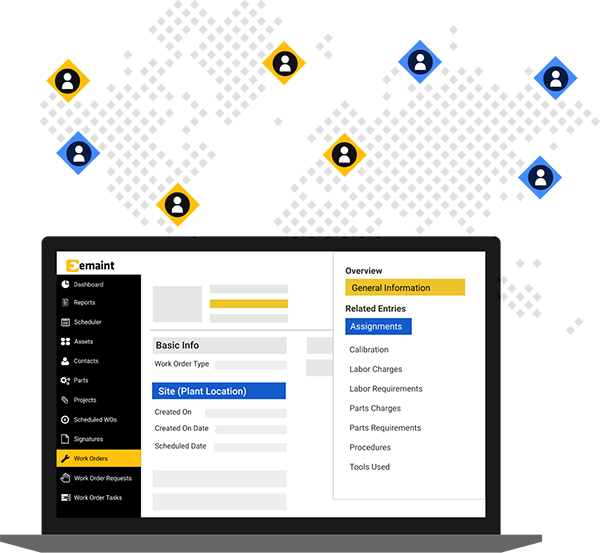
As you’d expect, scaling from single- to multi-site maintenance adds complexity, but the challenges aren’t obvious from your desk or dashboard — not at first, anyway.
When maintenance scales to multiple sites, the first things to break aren’t assets, tools, or KPIs. Instead, multi-site maintenance introduces a totally unique set of challenges related to alignment, consistency, and feedback loops, which are invisible in the early stages of scaling.
Why maintenance feels fine, until it doesn’t
Single-site maintenance often relies heavily on internal team communication. In-person collaboration lets maintenance teams learn from each other in real time, and there are things technicians “just know” by being team members.
Teams often rely on three types of maintenance:
- Tribal knowledge: This is shared among team members but isn’t documented. It includes repair workarounds that speed up processes, knowledge of which machines need an extra nudge to get started or operate correctly, and expert experience gained from working with the machine over time.
- Informal communication: Instead of placing a work order or documenting the need for a part, team members use word of mouth to notify others when they need something.
- Shared context: This is the shared understanding of the common vision and goals that drive maintenance practices. Everyone working at the same location knows the goals along with the reasoning behind them, even if they’re not documented.
These communication types disappear as companies add sites. Tribal knowledge isn’t shared across sites, informal communication is siloed at each individual site, and there’s no shared context between distributed maintenance operations.
Despite this, confidence in the systems present in individual sites maintains the illusion of control in multi-site operations for far longer than it should.
What breaks first (and why it’s hard to see)
Initially, operations may see improvements after adding a site. A new site increases overall output, and new machines often have great KPIs, which can make leadership (falsely) believe maintenance is running smoothly.
But early-stage failures can remain unseen until they cause operational disruptions:
- Diverging work execution across sites: Identical assets are managed differently, and similar tasks are performed inconsistently. PM procedures vary in both process and frequency, asset data is fragmented, and generating reliable KPI data becomes challenging.
- Inconsistent task interpretation: Teams may execute the same procedure differently or to varying standards. This often results in the failure to meet compliance initiatives, operational discrepancies, and unreliable documentation.
- Normalization of local workarounds: As technicians become more proficient with machines, they create their own workarounds to increase efficiency. Over time, these undocumented procedures become standard maintenance practice.
- Visibility challenges: Mobile and field teams operate with increasing autonomy, but poor documentation decreases visibility, a necessary element of big-picture decision making.
These are different from equipment failures; they aren’t tracked, nor are they discoverable in KPIs. Instead, these are process and alignment failures. They’re difficult to see, and they can be even harder to correct at scale.
Multi-site operations naturally increase field and remote execution. But as mobile maintenance becomes the norm, documentation and tracking often fall behind. Technicians often operate independently in the field, with little to no oversight. And that autonomy can mean a lower likelihood of catching errors before they escalate.
The mobile effect significantly slows the feedback loop. Errors and shortcuts persist longer before detection because metrics often lag reality, especially in more complex operations.
Why metrics lag reality at scale
During early scale, KPIs often stay flat or even improve. But maintenance metrics don’t show what’s happening in real time. Instead, most are lagging indicators — they measure the results of past actions.
Standard metrics often fail to capture:
- Execution drift: Minor shifts in processes like inspections, calibrations, cleaning, and other tasks
- Documentation inconsistency: Free-form fields, incomplete documentation, and different methods of documentation
- Decision-making delays: Inefficient workflow approval process or maintenance requests
As a result, leadership sees stable KPIs while risk is accumulating underneath. That’s why KPIs can’t be trusted to tell the entire story, especially at the beginning of multi-site maintenance.
Where multi-site operations start losing trust
When maintenance scales beyond a single site, trust is often the first casualty. It’s not because teams fail to do the work, but because the data stops telling a consistent, reliable story.
Asset histories suffer early in the scaling process. One site captures detailed failure modes and parts usage while another only logs basic completions. Over time, comparable equipment appears unrelated in records, undermining asset lifecycle planning — especially in energy environments where uptime is directly tied to operational risk.
Work order narratives follow suit. Free-form entries vary by technician, local standards, and language, creating ambiguity. In European operations spanning multiple countries, these inconsistencies compound, reducing cross-border visibility.
Decision confidence plummets as leaders shift from evidence to intuition for capital priorities, preventive/reactivebalance, or resource allocation. Cross-site comparisons become impossible, and clean-looking KPIs often mask incompatible inputs. Trending data becomes increasingly challenging.
Add distributed regulatory expectations across regions, and the challenges escalate. Inconsistent data makes proving control and consistency impossible, and audit failure becomes a significant risk.
Most multi-site maintenance issues don’t look like maintenance failures, but you can still find them if you know where to look.
Early warning signs to watch for
One of the earliest signals is a shift in language. When leaders hear, “Why does this site do it differently?” more often, it usually reflects undocumented process drift rather than intentional local optimization.
Other warning signs are related to communication breakdowns:
- Increasing rework or clarification requests as planners and supervisors interpret incomplete or inconsistent work order details
- Growing reliance on verbal explanations to fill gaps that the system should capture but doesn’t
- Difficulty explaining why decisions were made, especially around prioritization, deferrals, or spending
Individually, these may seem like people or process issues. But together, they point to a system that no longer scales with the organization and data that can’t support confident, repeatable decisions across sites.
What mature multi-site maintenance looks like
High-performing multi-site organizations don’t eliminate local differences — they make them visible, intentional, and comparable through strong maintenance governance.
These organizations achieve consistent execution without rigid uniformity, allowing sites to adapt to local assets, energy conditions, and regulatory expectations while upholding maintenance standardization.
Key characteristics include:
- Faster feedback loops from the field to planning, driven by clear, structured work order data and mobile maintenance execution that captures details in real time
- Shared definitions of “done”, so completion means the same thing across sites
- Trustworthy data, built through repeatable processes and disciplined inputs, ensuring accurate cross-site comparisons and reliable KPIs
With these foundations, leadership spends less time reconciling reports and more time driving performance improvements. The data becomes a strategic asset, supporting confident decisions and positioning the organization for advanced applications like predictive analytics and AI-driven insights.
Building mature multi-site maintenance from day one
The challenge of maintenance governance in multi-site operations isn’t limited to asset management. The challenge is building and maintaining trust in the data that drives decisions from the factory floor to the boardroom. Standardizing how maintenance work is captured, compared, and acted on creates the foundation for consistency today and data-driven decision-making tomorrow.
eMaint helps multi-site teams establish shared processes, reliable asset histories, and visibility across locations. The result is maintenance data leaders can trust, decisions they can defend, and operations that scale with confidence.