

Three types of maintenance software dominate the asset management software market: computerized maintenance management system (CMMS) software, enterprise asset management (EAM) software, and asset performance management (APM) software. Each solution can give you critical, data-driven insights into your operations and help you get the most value from your equipment.

So, what’s the difference between CMMS vs EAM vs APM? And how can enterprises choose between them?
It’s easy to get lost in the acronyms, so let’s break down what each system is, how they’re different, and how to leverage the right tech for your unique needs. Understanding the difference between EAM and CMMS software — and seeing how APM fits in — makes choosing the right tools easier.
CMMS vs EAM: What Is the Difference?
The difference between CMMS and EAM isn’t always obvious. That’s because CMMS and EAM software share some basic functionality.
Um sistema informatizado de gestão da manutenção (CMMS) acompanha as actividades de manutenção preventiva, a gestão do inventário e os catálogos de reparação. Entretanto, um sistema de gestão de activos empresariais (EAM) é uma rede abrangente de sistemas controlados, software e serviços dedicados à manutenção de activos físicos e infra-estruturas ao longo de todo o seu ciclo de vida.
In other words, an EAM is core to your asset health and lifecycle strategy. It is a holistic system that impacts every aspect of your infrastructure and asset management, including financial components such as depreciation, return on investment (ROI), and return on assets (ROA). In that sense, it can be more complex. However, both EAM and CMMS software seek to simplify insights.
Por outro lado, um CMMS é uma ferramenta que lhe permite centralizar e otimizar as informações que fazem parte do EAM. Permite-lhe automatizar tarefas, simplificar processos e aumentar a comunicação e a transparência entre o seu pessoal de manutenção. Um CMMS é também um centro de controlo para gerir o inventário de peças sobresselentes, monitorizar a saúde dos activos e executar a sua estratégia de manutenção.
However, an EAM offers additional functionality that puts the whole lifecycle of an asset into view — from acquisition to disposal.
This means that a CMMS can be a component of an EAM strategy. While a CMMS focuses on maintenance management, an EAM addresses the bigger picture of asset management beyond maintenance. The takeaway? You may not need to choose between EAM and CMMS software, since both are valuable tools in running your organization.
Qual é a diferença entre o software EAM e APM?
An EAM connects physical assets across many locations at once to measure the cost of acquisition and decommissioning. This helps extend the lifecycle of your critical machines. EAM software provides business analytics for enterprises that are focused on reliability. When coordinating long-term projects, an EAM ensures resources are being properly allocated toward task completion. In addition, unlike APM, EAM typically refers to an overall strategy, not a singular software.
Asset performance management (APM) software is a platform explicitly used for two purposes: 1) helping organizations get the most out of their assets and achieve operational excellence, and 2) delivering real-time data and insights about the monitored assets.
Using APM software can help you reduce unplanned downtime and extend the useful life of assets with remote monitoring of asset health and performance. This monitoring capability enables you to respond promptly where and when it matters most.
| Category | CMMS | EAM | APM |
|---|---|---|---|
| Typical users | Maintenance technicians, supervisors, maintenance managers | Asset managers, planners, finance & operations leaders in large organizations | Reliability engineers, data analysts, operations and performance teams |
| Best for | Managing day-to-day maintenance activities: work orders, preventive maintenance, inventory, compliance | End-to-end asset lifecycle management including maintenance, finance, procurement, and enterprise reporting | Monitoring asset health, predicting failures, and optimizing performance using analytics and condition data |
| Vantagens | Easy to implement and use; improves maintenance efficiency and asset uptime; lower cost and faster ROI | Centralized, enterprise-wide asset visibility; supports long-term planning and cost control; scalable across sites | Enables predictive maintenance; reduces unplanned downtime; improves reliability and performance through data-driven insights |
| Limitations | Limited lifecycle and financial visibility; minimal advanced analytics | Higher complexity, longer implementation, greater cost than CMMS | Not a full maintenance or asset management system; usually needs CMMS or EAM integration |
| Example scenario | A plant uses CMMS to schedule PMs, assign work orders, and track spare parts | A global manufacturer manages assets across multiple sites, tracking costs, depreciation, and long-term planning | A power plant uses sensor data and analytics to detect early equipment failure and prevent unplanned downtime |
Outros sistemas: Qual é a diferença entre CMMS, MES e ERP?
You may also hear about manufacturing execution systems (MES) and enterprise resource planning (ERP) software. We didn’t include these previously because they aren’t directly comparable to CMMS tools.
An MES focuses on production lines, helping manufacturers improve processes and increase efficiency. Since a CMMS focuses on maintenance management, rather than manufacturing, there isn’t much overlap.
On the other hand, ERP software is more robust. An ERP unifies core business processes across entire enterprise organizations. This can include finance, human resources, supply chain, customer relationship management, and much more. A CMMS is more specialized, designed to manage and optimize maintenance assets and tasks.
Definições de EAM, CMMS e APM
EAM, CMMS, and APM are all useful software systems for enterprises. You may end up choosing one solution or multiple, depending on your needs.
But before you make any purchasing decisions, and while you’re still weighing CMMS vs EAM vs APM, let’s define each system individually and explain how they work in practice.
O que é o EAM e o que faz?
An enterprise asset management (EAM) system helps you manage all of your organization’s assets, supply chain, spare parts inventory, financial systems, and more. Generally, EAM does not refer to just one software program, but to a strategy and ecosystem of multiple solutions working together to provide a holistic approach to asset lifecycle management. An EAM follows all stages of the asset’s life — from procurement through to disposal.
As vantagens da utilização de software EAM
Eis as cinco principais formas como um EAM pode impulsionar os esforços de gestão de activos da sua organização:
- Streamlined asset management: Centralize your asset management on a unified platform, with better control and integration.
- Maintenance made more efficient: Automate and prioritize maintenance tasks to reduce equipment failures and unnecessary downtimes, ensuring critical operations continue smoothly.
- Improved asset health and performance: Monitor real-time data from condition monitoring tools to preemptively address potential issues, keeping your assets in optimal condition.
- Regulatory compliance assurance: An EAM, like a CMMS, can simplify compliance with regulations through automated tasks and electronic documentation, ensuring consistent adherence to industry standards.
- Superior data-driven decision making: Leverage detailed analytics to identify trends, make informed decisions, and optimize your asset management strategies effectively.
Key Features of EAM Software
One of the key differences between EAM and CMMS is in the software’s scope. EAM offers a wide range of features to help users make decisions related to finance and maintenance. Those features include:
Gestão financeira
EAM software tracks all the expenses related to owning and maintaining each asset throughout its lifecycle. That includes repairs, spare parts, and preventive maintenance, as well as the initial purchase price.
Supply chain management
An EAM has built-in automated tools for inventory and supply chain management. This includes automated restocking, forecasting, and parts tracking throughout the supply chain.
Relatórios e análises
An EAM is a central repository for maintenance data, as well as inventory, budgeting, and financial data. Users can drill down into that data and create virtually any kind of reporting. Track expenditure, labor hours, asset health, or KPIs, all with a few clicks.
Gestão de ordens de trabalho
An EAM plans and monitors maintenance activities, from preventive maintenance schedules to predictive maintenance strategies. The software generates work orders and tracks them through to completion. It also maintains a searchable database for your work order history.
Para saber mais, consulte O que é a gestão de activos empresariais?
O que é o CMMS e o que faz?
Um CMMS é um software de manutenção para gerir activos, ordens de trabalho, inventário, manutenção preventiva, monitoramento de condição e muito mais.
Além disso, funciona como um centro de comando para programas de manutenção e fiabilidade e é uma base de dados centralizada para armazenar os seus dados de manutenção. Pode utilizar o seu software de ordens de trabalho para controlar as ordens de trabalho e obter informações sobre o estado e o desempenho dos activos, bem como controlar o inventário de peças sobresselentes em vários locais, ligando mesmo as peças às ordens de trabalho.
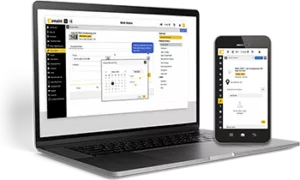
Muitos CMMS modernos também dão prioridade às suas aplicações de ordens de trabalho móveis para a gestão da manutenção em movimento. O CMMS móvel da eMaint até permite que as equipas trabalhem offline. Estas funcionalidades de gestão do trabalho também se revelam vitais quando se trata de simplificar a conformidade regulamentar.
Vantagens da utilização de um CMMS
Existem muitos benefícios na utilização de um CMMS, mas por uma questão de brevidade, reduzimo-los aos 5 principais. (Leia a nossa lista completa aqui: Um Guia Simples para os 13 principais benefícios do software CMMS.)
- Real-time work order updates: You can instantly update and streamline responses, therefore driving rapid and effective maintenance actions.
- Preventive maintenance planning: You can schedule maintenance tasks to prevent breakdowns and extend the lifespan of your equipment.
- Increased worker productivity: Boost efficiency by improving task management.
- Reduced equipment downtime: Concurrently, you can decrease operational interruptions to boost productivity and ensure continuous availability.
- Compliance and safety standards adherence: Uphold rigorous safety and compliance standards, mitigating risks and enhancing reliability.
Eis um exemplo para ilustrar a eficácia de um CMMS: A Pratt & Whitney, um conhecido fabricante de motores de aeronaves, implementou o CMMS eMaint para melhorar as suas operações de manutenção. Num único projeto, pouparam 100.000 dólares e evitaram três meses de inatividade por terem as peças certas disponíveis quando necessário.
Com o CMMS, a equipa pôde gerir o inventário de forma mais eficaz, mantendo o equipamento a funcionar sem problemas e reduzindo o tempo necessário para obter peças sobresselentes essenciais. O sistema também proporcionou um acesso fácil a relatórios e painéis de controlo, ajudando a equipa a monitorizar a utilização das peças e a antecipar quando seriam necessárias substituições, o que é fundamental para manter operações optimizadas.
Intrigued by the results a CMMS can drive? To learn more about what a CMMS can do, see What Is a Computerized Maintenance Management System?
Key Features of CMMS Software
CMMS software is laser-focused on maintenance management; it is a core difference between EAM and CMMS. Its features are purpose-built to streamline maintenance tasks, reduce downtime, and boost efficiency.
Gestão de ordens de trabalho
A CMMS handles every stage of work order management, from the initial work request and work order creation, all the way to completion. The software assigns maintenance jobs, tracks completion, and issues alerts as needed. It also stores key data from work order histories.
Gestão do ciclo de vida dos bens
CMMS software keeps detailed records of asset health, maintenance history, and expenditures throughout the lifecycle. It also stores data like an asset hierarchy, a preventive maintenance schedule, and even vendor information.
Maintenance reporting and analytics
CMMS software has excellent reporting capabilities, which make it easy to track KPIs like MTTR, MTBF, and MTTF. Users can compare metrics across different worksites, setting benchmarks and monitoring progress toward a goal.
Mobile functionality
A good CMMS solution offers a mobile app that allows technicians to access work orders while in the field. Check work order details, add notes, and mark tasks complete, even when you’re offline.
Compliance tools
Audit trails and customizable dashboards capture all your compliance data in one place, making it easy to demonstrate regulatory compliance. Signatures, inspections, and preventive maintenance records are available at the touch of a button.
At a Glance: Key Differences Between EAM and CMMS
CMMS and EAM software have much in common, which can make choosing between CMMS vs EAM difficult.
What really differentiates them is their focus and their scope. EAM software is designed to optimize efficiency by reducing costs across the enterprise. An EAM achieves this by tracking the total cost of asset ownership throughout its lifecycle.
From acquisition and maintenance to the cost of spare parts, all the way to decommissioning, EAM monitors cost and looks for ways to boost efficiency. EAM also takes into account enterprise-wide budgeting and financial goals as they relate to maintenance processes.
CMMS software is more narrowly focused on maintenance strategies. A good CMMS helps teams standardize their maintenance workflows, assign and track maintenance tasks, and create efficient preventive maintenance schedules. A CMMS also offers robust maintenance analytics for tracking maintenance metrics and KPIs.
A CMMS tracks spare parts inventory across facilities, manages work orders, and monitors regulatory compliance. It also monitors asset health and auto-generates work orders in response to changes in condition monitoring data.
Essentially, both CMMS and EAM software offer data-based insights that can improve maintenance practices. However, EAM software takes a broader, cross-department view, while CMMS software is concerned with maintenance processes.
Still unsure about CMMS vs EAM? Let’s see how APM compares to CMMS and EAM software.
O que é a APM e o que faz?
Um software de gestão de desempenho de activos (APM) centra-se na combinação de software de manutenção moderno com tecnologia como sensores para amplificar a gestão de activos. Um sistema de software APM recolhe e analisa dados monitoramento de condição para ajudar as equipas de manutenção a tomar acções orientadas por dados que reduzam falhas de activos e tempos de paragem não planeados - e, em última análise, prolongar a vida útil de um activo.
The Advantages of Using APM Software
- Faster recovery from outages: APM tools significantly decrease Mean Time to Recovery (MTTR), reducing risks from new updates and changes, while minimizing recovery needs through proactive monitoring.
- Rapid defect diagnosis: Enhance application stability and user experience with APM’s streamlined defect identification, which frees up time for innovation and reduces user churn.
- Reduced operational costs: Optimize resource usage with APM’s detailed performance insights, leading to significant cost savings in application maintenance and operation.
- Unified application insights: APM offers a comprehensive view across your application stack, improving team collaboration and managing complex environments more effectively.
Key Features of APM Software
Asset performance management (APM) software is designed to translate data points into an effective asset management strategy. APM features include:
Monitoramento de Condições
APM software monitors asset health data collected by IIoT sensors for real-time insights into each asset’s maintenance needs. An effective condition-based maintenance program enables technicians to make repairs as soon as an asset develops a fault.
Manutenção Preditiva
APM software relies on built-in analytics to effectively predict upcoming maintenance issues, based on condition monitoring data and historic asset data. The software doesn’t just diagnose existing asset faults — it anticipates emerging issues. This allows teams to set priorities and build efficient schedules.
Manutenção Preventiva
APM software drives a data-based preventive maintenance program. Instead of following a generic PM schedule, APM software builds a program based on each asset’s historic needs. The result is a more effective schedule, with a sharp reduction in unnecessary maintenance tasks.
To learn more, see What Is Asset Performance Management?

CMMS vs EAM vs APM: Which System Best Suits Your Requirements?
If you’re still confused after reading through those similar-sounding descriptions, it’s because CMMS, EAM, and APM providers increasingly deploy software features that diminish the differences between each.
Assim, um CMMS como o eMaint pode ligar-se a sensores como muitos APMs, e também tem integrações poderosas para se ligar a outro software através da empresa como um EAM. Cada organização precisa de decidir quais as características mais importantes para si.
Em última análise, a escolha do software depende provavelmente das funcionalidades de que a sua organização mais necessita.
Então, o que é que isto significa para a sua empresa? Vamos recapitular.
Quando é que precisa de um CMMS
Um CMMS é ideal para:
- Transição da gestão da manutenção em papel ou de sistemas digitais isolados, como folhas de cálculo, para uma abordagem mais centralizada e eficiente
- Melhorar a organização e a acessibilidade das informações sobre manutenção
- Racionalização das operações de manutenção para gestão de tarefas e eficiência
- Aumentar a eficiência global dos processos de fabrico e manutenção
Por exemplo, se a sua equipa cria milhares de ordens de trabalho por ano ou trabalha frequentemente no terreno, é provável que precise de um programa de software CMMS de topo para esses fins.
Quando é necessário um EAM
Um sistema EAM é mais adequado para organizações que:
- Exigir uma abordagem global da gestão do ciclo de vida dos activos, desde a aquisição até à eliminação
- Necessidade de integrar a gestão de activos com outros sistemas empresariais
- Pretende gerir todo o espetro de actividades de gestão de activos, incluindo manutenção, gestão de riscos e planeamento estratégico numa localização central
Não se esqueça de que a utilização de um CMMS pode fazer parte da sua estratégia global de EAM.
Quando é necessário um APM
As organizações devem considerar uma APM se:
- Dar prioridade à excelência operacional
- Necessitam de informações em tempo real sobre o desempenho dos seus activos para minimizar o tempo de inatividade e prolongar a vida útil dos activos
- Necessidade de monitorizar o estado e o desempenho dos activos em vários locais
- Desejo de implementar estratégias de manutenção preditiva baseadas em dados exactos e em tempo real
An example is Azima DLI, whose high-resolution vibration systems, wireless sensors, and automated vibration tools deliver diagnostic results about assets so that technicians can perform corrective actions immediately.
Key Questions to Ask if You’re Still Confused About CMMS vs EAM
If you’ve read through all this and still find yourself on the fence about which software to choose, let’s simplify it. Here’s how you might think about each option:
- Scope of management: Think about the daily management of your assets. Do you primarily need to keep up with maintenance schedules and work orders, or are you looking for a comprehensive solution that covers the entire asset lifecycle, including procurement and disposal? A CMMS is perfect for focused maintenance management, while EAM offers a broader, more holistic view of asset management.
- Complexity of your needs: Assess the complexity of your asset management requirements. If your organization deals with a wide array of assets that require detailed monitoring, reporting, and regulatory compliance, an EAM is likely more suited to your needs. If your focus is primarily on maintaining current assets with efficiency, then a CMMS might be sufficient. Want to explore a CMMS with EAM capabilities? Learn more about eMaint.
- Custom requirements: Every industry has its quirks. Does the software need specific features to comply with industry standards or to integrate with specialized equipment? You’ll need to check to see if the software can be tailored to meet these unique demands.
- Integration smoothness: Another consideration is just how configurable the individual provider has made their software. The ideal software should integrate smoothly with your current ERP, financial software, and other critical operational systems, enhancing data flow and reducing manual entry errors. eMaint, for instance, works with teams to decide which features they need and then offers help throughout the implementation process.
Tirar partido da APM, EAM e CMMS
Today’s CMMS, EAM, and APM solutions are a structured powerhouse to manage both maintenance work and physical assets to get the most out of people and machines. All come with their own benefits, but remember — choosing the right software is about more than just features — it’s about finding a solution that integrates into your workflow and enhances your asset management practices effectively.