
By Michael Mills, Technical Solutions Manager at Fluke Reliability
Updated: September 18, 2025 • Originally Posted: 2021 • 10 min read
What Is Enterprise Asset Management?
Enterprise asset management (EAM) is the practice of managing physical assets throughout their entire lifecycle, including acquisition, operation, maintenance, and disposal. The goal of EAM is to improve the reliability and longevity of assets, reduce costs, and optimize operations.
Enterprise asset management is critical to many businesses in a range of industries, from manufacturing to healthcare. In this article, we’ll cover everything you need to know, including the meaning of EAM, why it matters, what to look for in an EAM solution, and how different industries can make the most of EAM.
Table of Contents
- What Is Enterprise Asset Management?
- What Is an EAM System?
- How Does an EAM System Work?
- The Benefits and Importance of EAM Systems
- What Is the Difference Between EAM and CMMS?
- What Is the Difference Between EAM Asset Management and ERP?
- What Is the Difference Between an EAM System and an APM?
- Enterprise Asset Management Software Examples by Industry
- Seven Key Features To Look for in an Effective EAM Software
- Get Started With Implementing EAM Software
What Is an EAM System?
An EAM system is a network of systems, software, and services dedicated to the maintenance of physical assets and infrastructure throughout their entire lifecycle, from asset procurement to disposal. For organizations managing hundreds or even thousands of assets, having one enterprise asset management system allows them to optimize their asset management by keeping all asset data centrally located.
An EAM system ultimately lets organizations optimize the performance and efficiency of their physical assets and infrastructure while reducing operating costs and ensuring compliance with relevant standards. An EAM system also centralizes asset management across multiple sites. This means maintenance teams can more easily monitor and maintain assets, and decision-makers can identify trends, forecast failures, and prioritize investments based on actual asset health.
How Does an EAM System Work?
An EAM system works by collecting data and insights from software, sensors, Internet of Things (IoT) devices, and more, combining them into one holistic database. It’s highly customizable, so you can integrate software for enterprise resource planning (ERP), supply chain management, condition monitoring, scheduling, accounting, customer relationship management (CRM), and more.
With an EAM system, users don’t need to open individual programs or manually combine information from multiple sources. Instead, the EAM system integrates each source for you, uniting your data.
The Benefits and Importance of EAM Systems
Organizations can have hundreds, if not thousands or millions, of assets to keep track of and maintain. Managing each of these assets throughout its lifecycle requires implementing a robust strategy to efficiently and transparently manage them at every stage, from purchase to disposal. An enterprise asset management system benefits companies by providing these capabilities and more.
Let’s review some of the most critical benefits of implementing a strong EAM strategy and system in your facility operations.
Centralize Asset Data
One of the greatest benefits of using an EAM strategy and EAM software is that the system can automatically pool data from disparate systems and multiple facilities and sites. By having a single source of truth, operations managers and facility crews can more easily monitor and maintain assets throughout their lifecycle, regardless of location. This centralization has a ripple effect, too, leading to many other benefits such as better communication, increased transparency, enhanced Root Cause Analysis (RCA), and more.
Easily Track and Manage Assets and Infrastructure
Another strong benefit and capability of EAM is better, more efficient asset tracking and Asset Lifecycle Management (ALM). Facility staff and decision-makers can get real-time reports on current performance health and the expected state of infrastructure and assets. They can also receive alerts from the system when they need to take actions like scheduling and performing routine maintenance. And AI-powered EAM systems further enable predictive maintenance by automatically gathering real-time condition data about each asset and using machine learning algorithms to determine when and where maintenance is required.
Resolve Issues Before They Happen With Predictive Maintenance
With centralized data and AI-powered asset management comes predictive maintenance. Predictive maintenance is especially important for facilities’ operations because it allows organizations to avoid unplanned downtime and plan any necessary downtime so it’s as short as possible. By knowing which assets will need repairs and when, facility managers can ensure the team stays on track for hitting production and operations goals while minimizing any impact on revenue and costs.
Extend Asset Lifecycles
Staying on top of asset maintenance and repair needs with predictive maintenance through an EAM system reduces unnecessary mechanical stress on assets. Of course, less mechanical stress on assets means they last longer. These extended lifecycles lead to reduced replacement budgets and operational costs by minimizing costly operations like emergency maintenance, helping companies maintain a healthy bottom line, and keeping operations more sustainable.
Optimize Maintenance, Repair, and Operations (MRO) With Work Order Automation and Scheduling
A modern, powerful EAM system can also automatically create work requests and display the progress of each work order to help simplify Maintenance, Repair, and Operations (MRO). This sort of real-time, centralized automation eliminates tedious administrative work and lets staff get updates autonomously. Together, these functions streamline maintenance processes and eliminate communication bottlenecks.
Additionally, a modern EAM system makes it easy for operations managers and other users to optimize work schedules for employees and contractors to ensure the right people complete maintenance activities at the right time.
Streamline Supply Chain and Inventory Management
Of course, by optimizing MRO, a holistic EAM system also facilitates a more efficient supply chain and inventory management strategy. How and when parts are purchased and whether critical spares arrive on time to solve production line shutdowns can make a powerful difference in reducing downtime. And top EAM solutions work alongside Enterprise Resource Planning (ERP) and financial systems to provide all kinds of inventory management and stock controls, such as purchasing and managing spare parts, predicting the demand for materials, and automatically reordering stock that is running low.
Eliminate Supply Shortages and Minimize Downtime
By optimizing supply chain processes, preventive maintenance, data centralization, and automation, an EAM delivers precise visibility into when assets will need to be taken offline for repairs. This insight enables accurate spare parts planning, minimizes unplanned downtime, and ensures asset utilization remains high.
Simplify Audits
Besides all the other benefits of using EAM software, good EAM systems also make it easier for organizations to prepare for audits and maintain regulatory compliance.
For instance, in the food and beverage industry, an EAM solution can help prepare facilities for FDA audits by centralizing critical data like inspections, when machines and other infrastructure were last serviced, and more. And in healthcare, organizations that utilize an EAM strategy have streamlined digital records that make it much easier for teams to keep their machinery and equipment safe and provide maintenance and upkeep records for audits.
What Is the Difference Between EAM and CMMS?
To some, an EAM system and a computerized maintenance management system (CMMS) might seem to be essentially the same thing. Though there is some overlap in their capabilities, there are some distinct differences, too. So, what is EAM software, and how does it differ from a CMMS?
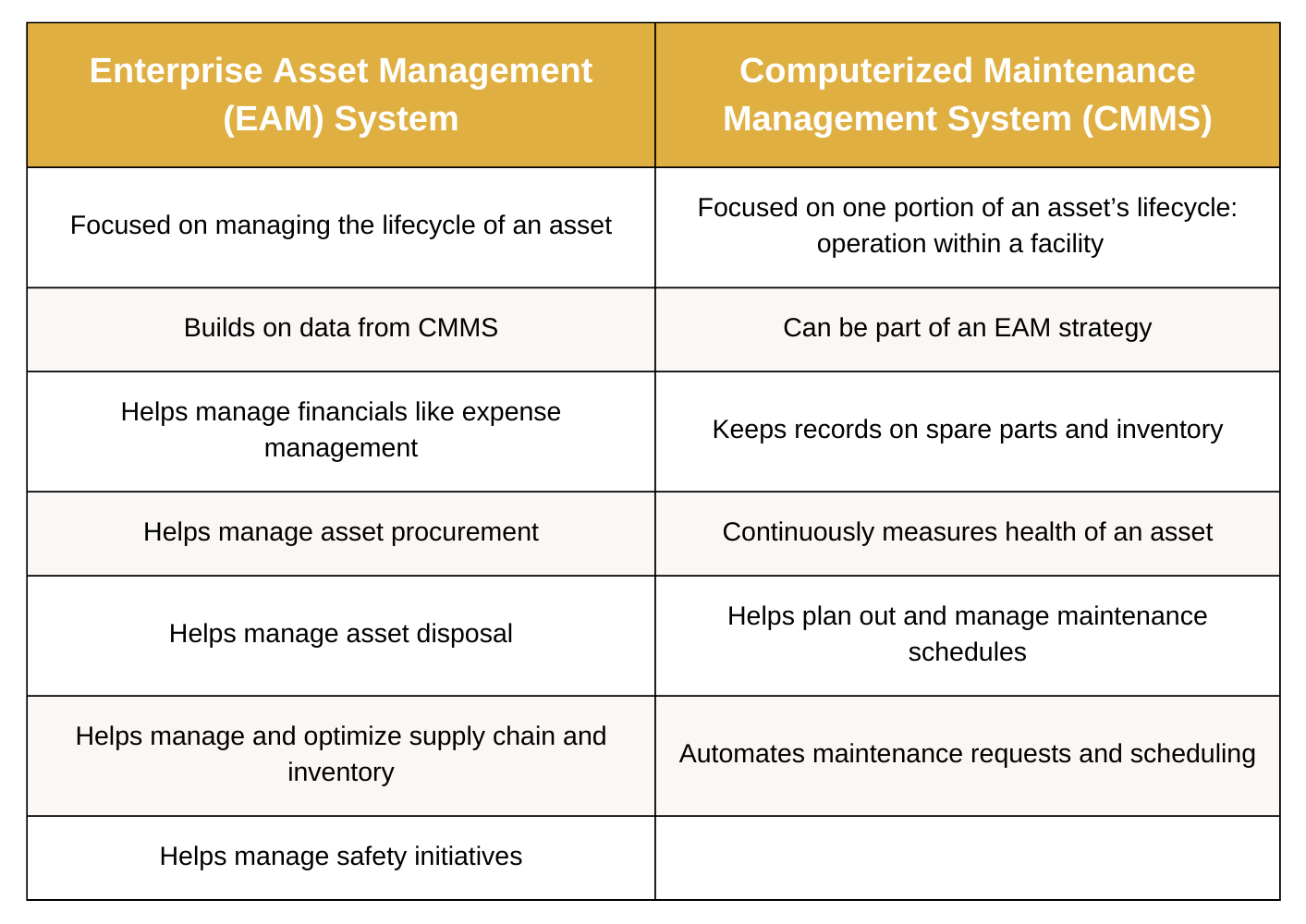
The primary difference between an EAM system and a CMMS is that an EAM system centers on asset lifecycle, while a CMMS is software that helps manage asset data while the asset is in use.
For instance, an EAM system helps track data and tasks related to every stage of the lifecycle of an asset or piece of infrastructure, from procurement and regular maintenance to repairs and disposal. This includes capabilities related to accounting and expense management, planning and scheduling, reporting and analytics, supply chain and inventory optimization, management of safety initiatives, and much more.
Meanwhile, a CMMS is more focused on recordkeeping for items and tasks like tracking and ordering spare parts and inventory, measuring continuous asset health, and planning maintenance schedules. A CMMS can help optimize and streamline these tasks — which can apply to anything from machines to fleets, and even to entire facilities — via automation and by improving transparency and communication. However, all of these benefits and tasks revolve around the active portion of an asset’s or piece of infrastructure’s life.
In short, EAM is a more holistic system that touches every aspect of infrastructure and asset management. While a CMMS can fall under the umbrella of an EAM strategy, it specifically focuses on maintenance management while an asset is operational.
What Is the Difference Between EAM Asset Management and ERP?
Enterprise asset management (EAM) and enterprise resource management (ERP) have many areas of similarity. Broadly, both EAM asset management solutions and ERP solutions provide a data-driven approach to asset maintenance and asset performance management. Both ERP and EAM systems act as central repositories for storing and managing data, including asset data.
However, there are significant differences between these platforms. ERP is designed for high-level insights into the financial management of the entire organization. It’s concerned with asset management, but only as it fits into the larger scheme of enterprise management. An ERP does provide functions like asset performance management and inventory management, but its broader functionality is concerned with budgeting and forecasting for the enterprise, as well as managing the larger costs of business operations.
EAM, on the other hand, is focused on the nitty-gritty of asset management. EAM asset management functionality includes everything necessary for the maintenance of physical assets, which includes manufacturing equipment, vehicles, and facilities equipment like coolers and HVACs. All of the routine maintenance and long-term decision making that keeps physical assets operational can be handled by an EAM solution. EAM functions include maintenance planning and scheduling, supply chain management, and asset management. Data-driven maintenance programs like predictive maintenance are also supported by EAM systems rather than ERPs.
What Is the Difference Between an EAM System and an APM?
Both EAM solutions and APM, or asset performance management tools, are designed to improve the performance of critical assets. However, they have different scopes and scales.
EAM systems focus on the big picture of asset management. They consider the broader needs of asset lifecycle management, especially as it relates to enterprise-wide issues like budgeting and planning. An EAM system is concerned with asset acquisition, procurement, and risk mitigation, in addition to the routine maintenance and upkeep associated with asset management.
In contrast, APM is laser-focused on optimizing asset performance and availability. APM uses data analytics and strategies like predictive maintenance to improve maintenance processes so that assets are always performing optimally, with minimal unplanned downtime and outages.
Enterprise Asset Management Software Examples by Industry
Any asset-intensive organization can use enterprise asset management to improve its operational effectiveness by automating and optimizing maintenance, scheduling, repairs, compliance, and other tasks.
EAM enterprise asset management systems are used by the life science, healthcare, petroleum, and railway industries because of their potential to transform the future of manufacturing through AI, the Internet of Things (IoT), and SaaS integrations. Reducing maintenance costs and extending the longevity of assets allows for greater transparency and accountability across the organization.
Here are some ways different industries use EAM software:
- Life sciences and pharmaceuticals: EAM software can help companies operating in the life sciences and pharmaceutical space with compliance and with better managing and maintaining precision equipment like centrifuges and manufacturing assets like tablet presses.
- Food and beverage manufacturing, storage, and distribution: An EAM solution can help prepare food and beverage facilities for FDA audits, simplify meeting compliance standards, and decrease budgetary burdens.
- Automotive manufacturing: Implementing EAM software can help standardize operations across production lines and facilities and meet strict International Automotive Task Force (IATF) regulations.
- Fleet maintenance: Leverage an EAM to manage fleet asset repair and maintenance and track key metrics such as total cost of ownership (TCO).
- Healthcare: An EAM strategy streamlines and digitizes recordkeeping, which helps teams keep healthcare facilities safe and healthy, meet compliance regulations, and more easily pass audits.
- Information technology (IT): An EAM can unlock powerful capabilities for enterprise IT asset management, whether for IT companies or internal IT departments.
Seven Key Features To Look for in an Effective EAM Software
Not all enterprise asset management solutions are created equally. In fact, some are tailored to specific industries. However, regardless of industry, there are some essential components, features, and functions that every modern EAM software should have.

1. Work Order Management
Work orders are the backbone of successful enterprise asset management. A good EAM system will have automated work orders for planned preventive maintenance, a simple-to-use interface for technicians, and customizable work orders that you can design to fit the needs of your organization. If you’re using predictive maintenance, the EAM should automatically trigger work orders based on predictive data.
2. Asset Lifecycle Management (ALM)
If you don’t know how your assets are performing, you risk costly, unnecessary downtime. You can be at a financial disadvantage when it comes to procurement and disposal, too. For instance, if you know you’ll need to purchase multiples of the same type of asset soon, you’re in a better position to save with a bulk purchase.
The best EAM software should have an asset database that gives you the ability to quickly and easily determine how far an asset is into its lifecycle. It should also help you manage and keep records of all the administration involved in procurement, active maintenance and repairs, and asset disposal.
3. Supply Chain Management
Just as it helps you manage the lifecycle of an asset, a robust enterprise asset management system should also help you keep track of your supply chain. By integrating with other critical systems like accounting software and ERP systems, EAM software should give you purchasing and inventory management capabilities. Features like searchable inventory counts and abilities like submitting requests for spare parts from other facilities in your network can help ensure your supply chain remains agile and lean.
4. Remote Asset Monitoring
It’s not uncommon for a business to have a sizable network of facilities and assets spread across large geographic areas. In these cases, it’s nearly impossible to effectively monitor and manage assets without remote capabilities. Any EAM system you use should give you the ability to see how any asset, at any facility, is performing — even if you’re off-site. This remote monitoring allows organizations to seamlessly plan, execute, and analyze maintenance or production activities in one centralized system.
5. Mobile and Cloud Capabilities
In addition to remote monitoring capabilities, the best enterprise asset management software should offer mobile and cloud capabilities. Cloud capabilities mean critical data is available whenever staff members need it — not when they’re hardwired into the local network. And an app that runs on tablets or smartphones lets facility staff and other relevant workers get updates and have access to the data and functions they need, like work order requests and inventory levels, while they’re on the go at facility sites.
6. Audit-friendly Features Like Audit Trails
An EAM system should make audits easier than ever. Look for features and functions such as time-stamped audit trails, password-protected e-signatures, data encryption, and more. Whether your organization needs to comply with FDA, OSHA, ISO, or other regulatory authorities, your EAM should make it easy to prove compliance.
7. Analytics and Reporting
Finally, any EAM worth implementing should provide you with powerful, real-time analytics capabilities. With a centralized data source to assess, your EAM should be able to identify critical patterns and create easy-to-read, actionable reports and dashboards. From information like maintenance KPIs and supply chain data to maintenance and labor costs, a modern EAM should help you understand what’s working and what isn’t.
Get Started With Implementing EAM Software
Now that you know the many benefits of, applications for, and features to look for in an enterprise asset management software, it’s time to consider which solution will work for your business.
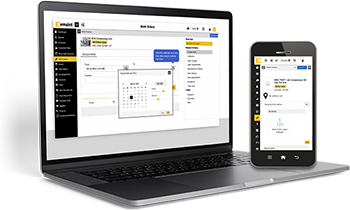
eMaint offers all the best of an EAM solution, combining CMMS, EAM, and condition monitoring capabilities. Organizations across a wide array of industries — from automotive manufacturing and food and beverage to healthcare and oil and gas facilities — can benefit from the deep, holistic capabilities and features eMaint offers users.
Customizable dashboards and reporting from eMaint EAM give you a comprehensive, easy-to-digest view of complex operations and assets. Plus, automation and real-time, centralized data let your team work swiftly and accurately together, providing the data and visibility you need to identify bottlenecks, improve efficiencies, and ensure maximum uptime for all of your assets.
The award-winning eMaint CMMS allows users to develop multi-asset work orders, inspection-round work orders, and work orders that automatically trigger based on condition monitoring data.
And eMaint mobile lets your team members capture critical data even when they’re offline; once they’re back online, eMaint Mobile automatically syncs to the cloud, so your crew can do their work when they need to and move on to the rest of their to-do list.
To learn more, take a tour to explore all the ways that eMaint can help your business.
About the Author
Michael Mills is a Technical Solutions Manager at Fluke Reliability, leading a team of solutions engineers dedicated to innovation and excellence in applying maintenance, reliability, and operations (MRO) strategies to CMMS and EAM implementation. With over a decade of experience in Enterprise Asset Management (EAM), Reliability Centered Maintenance (RCM), Condition-Based Maintenance (CBM), Integrated Condition Monitoring (ICM), Mills is an authoritative thought leader in the realms of asset management, mobile CMMS deployment, and IIoT monitoring.